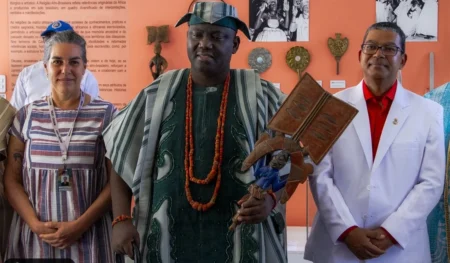







Ms. Cristian Munduate, the United Nations Children’s Fund (UNICEF) Representative in Nigeria, in this interview with CHIOMA UMEHA, stresses the urgent need for the country to pay more attention to children’s healthcare, collaborative efforts among government, religious, traditional leaders, and communities for effective vaccination, among other issues. Excerpts:
What changes need to be made to ensure that Nigerian children receive high-quality medical care?
We really need to amplify attention on primary healthcare, not only from the government but also from religious and traditional leaders and communities, so that they can step in. They can take action so that children can receive preventive healthcare. Therefore, vaccination is essential; it’s crucial. Nutrition is needed. Food security in the nation is a complex issue, but mothers should take their children to health facilities to access care promptly. At the ward level, these primary healthcare clinics can also screen children to make sure they are okay. Those who are not well can also receive therapeutic food so that they can survive.
Open defecation is another factor that needs attention. People need to understand that open defecation contributes highly to the deaths of not only children but also adults. People can catch cholera from open defecation, and it can be fatal. It is impossible to have access to healthcare services and a clean environment. They collaborate with each other. Thus, every community ought to endeavour to construct latrines in order to have a sanitary facility at the very least. Of course, having more modern sanitary facilities is desirable, but in many communities, this is not the reality. However, the practice is unacceptable.
What are the primary issues contributing to the significant health challenges observed in Nigeria?
The issue is a dearth of ward-level health centres. The establishment of health centres at the ward-level is necessary. You must have the service for a nation the size of 200 million people, where eight million kids are born annually. Without this service, these children will not be able to survive. Furthermore, if parents and the community do not realise and accept that using primary healthcare facilities is necessary to guarantee that children receive the recommended vaccinations, there is no chance the children will survive.
Nigeria is one of the lowest countries in the world, with children not being immunised or partially immunised. It can be argued that this falls under the purview of the government’s duties. However, many people have false notions, and because of this choose not to vaccinate their children. After becoming ill, some of them die. About 6.2 million Nigerian children have either missed their vaccination or have not even received it at all. To help close this gap, we must insist and write to push the political will to increase budgetary allocation to education. This is the only way. It is an urgent task that needs to be completed. We also have a task to not only have people informed, but to ensure all stakeholders must be mobilised to make a sincere commitment.
Last year, we had a diphtheria outbreak in Nigeria. Normally, children have diphtheria before five years of age. However, every child who contracted diphtheria the previous year was between the ages of 8 and 12. These were kids who had never received a vaccination. That means that parents also have some of the responsibility.
Nigerian children are the worst for malnutrition; how can mothers make a difference?
The best way to keep nourishing your child in the first two years of life is by breastfeeding. However, a lot of women choose not to breastfeed for a variety of unproven reasons. If you do exclusive breastfeeding for the first six months and then complimentary breastfeeding for the next one year and a half, you are guaranteeing your child is immunised because this is what it’s all about. Breast milk from a mother aids with a child’s nourishment and immunisations.
In actuality, throughout the first six months of life, no other diet can match the nutrients that mother milk offers. Breast milk ensures that the child grows healthily and thrives because of the micronutrients the milk contains. And they will become very tall.
Based on your professional experience in Nigeria, what do you expect from Nigerian mothers in terms of child care?
Motherhood is set by nature, and there is a bond. So, we need to put in more effort to take care of our children. I must say I’ve been in some health facilities where I have seen babies that are thriving, are very small for their age, and are very ill. But their mothers are healthy. So, at times, it’s not poverty. At times, it’s a lack of commitment and appropriate information. So, health workers, including the media, have to expand the message about why it is important for mothers to breastfeed their children. They just need to drink water and, of course, eat well. There’s no need to drink anything else. And then the milk is produced. They don’t need to expend extra money. Once they are well hydrated, they can produce sufficient breast milk for their babies.
They also need to go to the health facility to get, for example, doses of vitamin A and micronutrients. Last year, UNICEF fortified almost 32 million children, including adolescents, with vitamin A. Vitamin A is good to prevent and cure anemia. They should insist on getting vitamin A at the health posts and facilities as it is free.
How do you perceive the impact of myths and misconceptions, particularly those related to moral concerns, on mothers’ decisions to bring their daughters for HPV vaccination?
The principles with which the child is raised come from the family. So the HPV vaccine has nothing to do with all these misconceptions that this is enabling early practice of sexual relations. But the truth is that once the girl reaches adulthood, there is a possibility of her getting exposed to HPV. In Nigeria, when girls get married, they cannot tell how many other sexual partners their husbands might also have. Having multiple sexual partners is the best way through which HPV gets transmitted in the community. This is the best way to get cervical cancer. Cervical cancer is the only thing that the HPV vaccine prevents. Additionally, nursing also lowers the risk of breast cancer.
In Nigeria, we have bad health indexes; what factors do you think contribute to the trend?
Well, low budgetary allocation to health is contributing to it. It has been a long since we had a census in Nigeria. Because of this, it is challenging to properly prepare for what is required in each ward and local government region given the size of the nation. The census is the only exercise that can give accurate information. Now the question is, in a country with 200 million people and eight million babies being born every year, we don’t need to have an excuse that we don’t have data. By the time we have data, we can have good plans, but if they are never implemented, it doesn’t make a difference. Lives will still be lost. So, we need to take action. So, right now we need to speak about results for children. We need to mobilise so we must engage with the state authorities and the federal authorities to mobilise information so people can understand what the issues are.
You just said that we need to speak about results for children. Please explain.
Results, like ensuring all children get immunized. Nigeria has less than 51 percent immunisation against diphtheria, tetanus, and pertussis. Other countries in this region have over 80 percent, even countries that have political complications. The DRC and Burkina Faso, for example, are smaller countries with a smaller population. Despite the complex political situation, they are keeping the gains and the results. So we need to accelerate results.
Women at the grassroots, including in hard-to-reach areas, lack access to newborn care services like the Level 2 Newborn Units donated by the United Nations Children’s Fund (UNICEF) and others at Jericho Specialist Hospital in Ibadan. How do you see this?
Yes, it is because some wards do have primary health facilities. The midwives and nurses can determine whether the woman will experience birth issues if she visits the health centre for prenatal care. They can then refer to a higher level of care with such facilities as the newborn unit. This is not an acceptable justification because better primary health care services might fill this gap. Because Nigeria is a country where children cannot wait, the federal government is currently working on a sector-wide approach to properly organise the health system. We hope this may begin its implementation as soon as feasible. But still, we want all women to look for prenatal care to ensure safe mothers and healthy babies.
Despite progress made in childhood diseases, pneumonia, malaria, and diarrhoea remain major problems and the leading killers of children. What other strategies should be adopted?
Since diarrhoea, malaria, and pneumonia all kill children, they are related problems. Good sanitation is also important for their control in communities and public institutions. Dirty ponds are breeding sites for mosquitoes. I was with the Benue State governor and vice governor. Their priority for Benue State is malaria. So, we will engage with them. Additionally, they have pledged funding for studies and initiatives like searching unvaccinated children’s homes door to door. A lot of individuals believe that a vaccination against malaria will soon be available in Nigeria. This is already the case in a few African nations. We have to see if this is decreasing the malaria incidence rate. The gap has been for a long time; it did not appear a year ago. Since young adults present both the greatest opportunity and the greatest risk from illegal substances, criminality, and other issues, we must truly support all Nigerians in their development and survival. This support should specifically focus on children and young adults. Young people are affected because they lack opportunities.
Read the full article here