








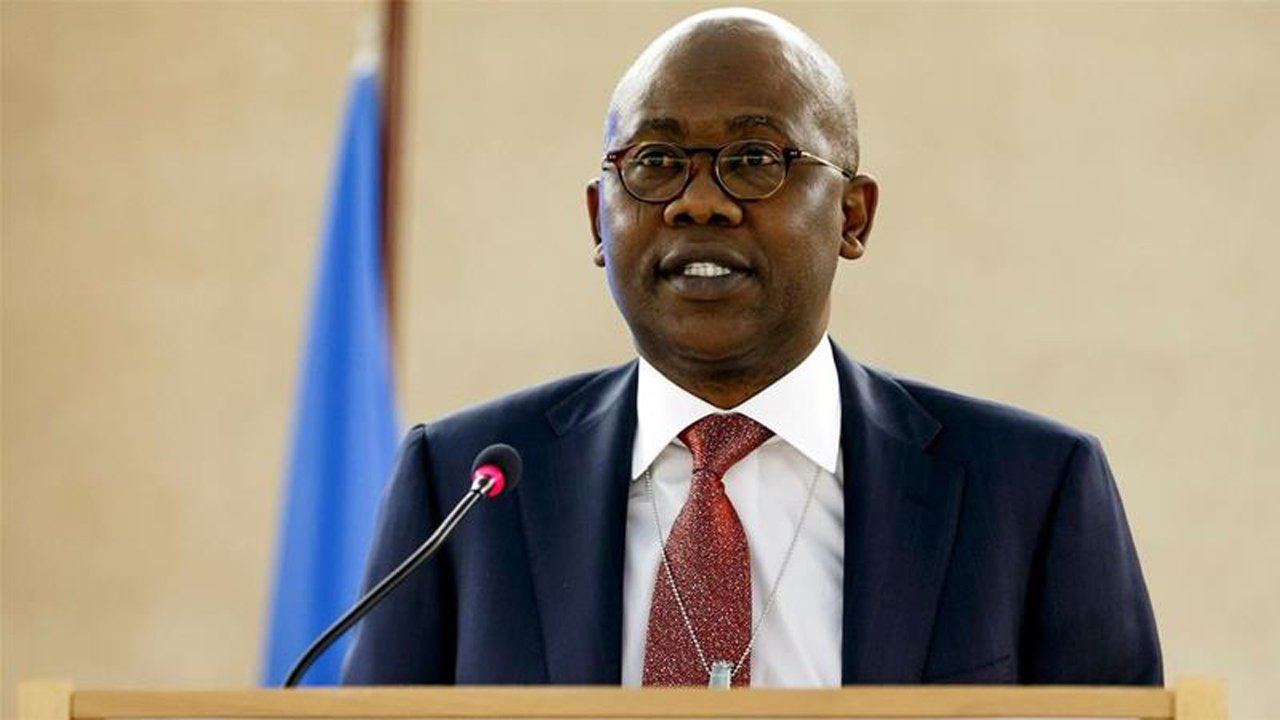
Former Attorney-General of the Federation, Mohammed Adoke, has called on the Nigerian government to offer him an “unreserved apology” over what he described as years of persecution and humiliation linked to the controversial OPL 245 oil block deal.
In a statement on Friday, Mr Adoke welcomed the federal government’s decision to implement the OPL 245 resolution agreements, nearly 15 years after the administration of former President Goodluck Jonathan attempted to resolve disputes surrounding the oil-rich block.
“I wholeheartedly welcome the decision of the Federal Government of Nigeria to finally implement the OPL 245 Resolution Agreements nearly 15 years after the administration of President Goodluck Jonathan resolved the knotty disputes between the concerned parties and tried to set the oil-rich block on the path to productivity,” he said.
On Thursday, President Bola Tinubu announced the resolution of a decades-long dispute over Oil Prospecting Licence (OPL) 245, one of Nigeria’s most commercially significant deepwater oil blocks.
The presidency said the agreement paves the way for development that could add approximately 150,000 barrels per day to Nigeria’s production capacity.
Although details of the agreement are still sketchy and were not made public, the president’s office described it as a “historic settlement” that would unlock the development of one of Nigeria’s most strategically important deepwater resources.
Background
OPL 245 was originally awarded to Malabu Oil and Gas by the regime of General Sani Abacha in 1998.
Under the terms of the award, Malabu — a briefcase company set up by Mr Abacha’s son and the then petroleum minister, Dan Etete, in controversial circumstances — was required to develop the block in partnership with an international technical partner and pay a signature bonus of $20 million.
The company paid only $2 million before entering into a joint operation agreement with Shell Nigeria Ultra Deep Limited (SNUD). Malabu received its operating licence in April 2001, but it was revoked three months later, in July 2001.
The administration of former President Olusegun Obasanjo subsequently invited ExxonMobil and Shell — Malabu’s technical partner — to bid for OPL 245 in partnership with the Nigerian National Petroleum Corporation (NNPC). Shell won the bid and began work on the block.
Malabu accused Shell of conniving with the government to seize the block and petitioned the House of Representatives, which directed the federal government to re-award Block 245 to the company.
Malabu also approached the Federal High Court in Abuja, but the suit was struck out. While an appeal was pending, the then Minister of State for Petroleum, Edmund Daukoru, sought an out-of-court settlement on behalf of the federal government.
The block’s association with Mr Etete — whom the federal government alleged had awarded the block to himself while in office — inflamed opinion in the Niger Delta, where communities demanded a full audit of oil block allocations and disclosure of the ethnic identities of their owners.
The Obasanjo government eventually reversed course, reclaimed OPL 245 from Shell, and re-awarded it to Malabu on the condition that the company pay a new signature bonus of $210 million, in addition to the $2 million earlier paid in 1998.
Malabu paid the sum and withdrew its court cases, but the settlement created another dispute.
Shell filed for arbitration at the International Centre for Settlement of Investment Disputes (ICSID) in Washington, D.C., and also instituted proceedings at the Federal High Court in Abuja. SNUD, which had entered into a Production Sharing Contract with the NNPC in 2002, had paid $1 million of the $210 million signature bonus and held the remaining $209 million in an escrow account with JP Morgan pending resolution of the dispute.
Shell sought compensation and damages exceeding $2 billion, citing costs incurred in de-risking the block.
Several settlement efforts followed, though none produced a definitive outcome. However, a Terms of Settlement Framework was adopted in 2006.
In April 2011, under the Goodluck Jonathan administration, then Attorney-General Mohammed Adoke brokered a Resolution Agreement.
Under the agreement signed on 29 April 2011, Malabu agreed to waive all claims to OPL 245 in exchange for compensation from the federal government. Shell, in turn, agreed to withdraw all suits against the government and to pay, through the federal government, the sum of $1.092 billion as full and final settlement of Malabu’s claims. The block would then revert to Shell and its new partner, Italian oil company Eni.
In June 2013, the matter was formally concluded on those terms, and presidential approval was granted for the payment of $1.092 billion to Malabu — now controlled by Mr Etete after scheming out the Abachas — from the federal government’s escrow account at JP Morgan in London.
Italian trial and acquittals
The deal later attracted international scrutiny. Italian prosecutors alleged that most of the $1.3 billion purchase price for OPL 245 had been siphoned off to politicians and intermediaries.
PREMIUM TIMES reported that about half of the funds were transferred to the accounts of controversial businessman Abubakar Aliyu, believed to be a front for senior government officials.
Shell and Eni, along with several of their former and current executives — including Eni CEO Claudio Descalzi — were tried in Italy. All were acquitted in 2021 after denying any wrongdoing.
In Nigeria, Mr Adoke was later named in the $1.1 billion scandal. The Economic and Financial Crimes Commission (EFCC) accused him of benefitting fraudulently from the deal he had helped broker as Attorney-General.
He was arraigned before the FCT High Court in Abuja in February 2020 on a 40-count amended charge of bribery and related offences alongside Mr Aliyu, Rasky Gbinigie, Malabu Oil and Gas Limited, Nigeria Agip Exploration Limited, Shell Nigeria Extra Deep Limited, and Shell Nigeria Exploration Production Company Limited.
The EFCC later admitted it lacked sufficient evidence against Mr Adoke, and the court dismissed the charges. In a separate case at the Federal High Court, the EFCC accused him of laundering N300 million allegedly derived from bribery. He was also discharged and acquitted in that case.
In his book (The Burden of Service) published last year, Mr Adoke described the OPL 245 litigation as “as lucrative as OPL 245 itself for lawyers and their allies” during the Buhari administration. He characterised it as “a monumental waste of resources.”
Mr Adoke has continued to deny any wrongdoing, maintaining that no federal government money went missing and that those who brokered the 2011 settlement should be credited for civic patriotism, having saved the government from financial embarrassment arising from mismanagement of the original award process.
Commendations
Following Thursday’s announcement, Mr Adoke also commended President Tinubu for resolving the long-standing dispute.
“I also commend President Bola Ahmed Tinubu, GCFR, for finally resolving this thorny issue in the national interest and in the spirit of statesmanship,” he said, adding that the decision reflects the president’s understanding of the economic importance of the asset.
READ ALSO: Tinubu announces ‘historic’ deal to end decades-long OPL 245 controversy
The former justice minister criticised the administration of former President Muhammadu Buhari, accusing it of politicising the matter and undermining efforts made during the Jonathan administration to resolve the dispute.
“This is a further indictment of the President Muhammadu Buhari administration, which decided to scandalise and criminalise the hard work we did in the national interest to resolve the disputes caused by the unilateral revocation of the oil block by President Olusegun Obasanjo in 2002,” he said.
Mr Adoke said he suffered reputational damage both within and outside Nigeria due to his role in resolving the dispute.
“It is most unfortunate that I was subjected to humiliation and defamation home and abroad for the patriotic role I played as the Attorney-General of the Federation and Minister of Justice in resolving the dispute to get this vital national asset working,” he said.
He argued that the Nigerian economy would have benefited earlier if the matter had not been revisited by the Buhari administration and anti-corruption campaigners.
“If the Buhari administration and the trophy-hunting anti-corruption activists had not dragged the country backwards with their uninformed intervention, the Nigerian economy would have been far better off today,” he said.
Mr Adoke maintained that the latest development vindicates his actions and that the government should apologise for the treatment he received.
“I strongly believe that I deserve an unreserved apology from the Federal Government for the persecution and humiliation I was subjected to for nine years and the scar I still bear in my body simply because I advised the Goodluck Jonathan administration to do the right thing on the oil block,” he said.
The former attorney-general said he has forgiven those he believes were responsible for the damage to his reputation.
“Nevertheless, I forgive all those who connived to smear my name across the world. I take it as part of the burden of service to my fatherland. I remain steadfast and unshaken in my belief in Nigeria,” he said.
Read the full article here