





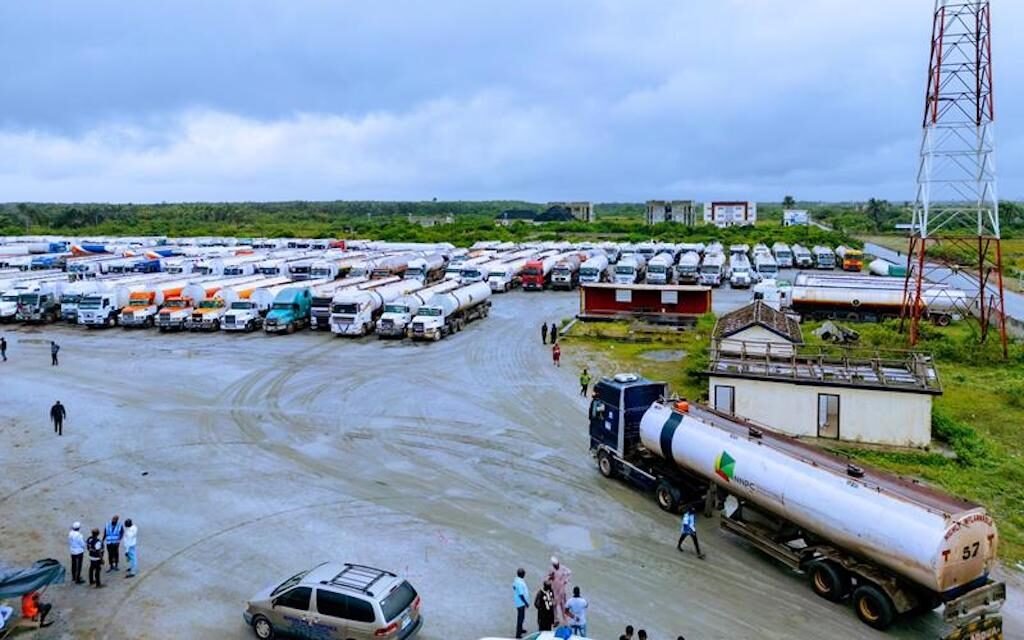
The Dangote Petroleum Refinery has increased its petrol gantry price by N121, raising the ex-depot rate from N874 to N995 per litre amid lingering volatility in global crude oil markets.
A top official of the refinery confirmed the price adjustment to PREMIUM TIMES on Sunday afternoon, stating that the change reflects the cost of crude currently being imported by the company amid the continuous escalation of the United States–Israel war with Iran.
“Coastal delivery is N948, while gantry is N995,” the official told this reporter in an interview, justifying the reason for the increase.
Following the adjustment, major filling stations in Abuja quickly revised their pump prices. A survey of filling stations in the city on Sunday showed that most outlets were selling petrol at N1,100 per litre — a significant jump from the prices recorded on Friday and Saturday.
PREMIUM TIMES observed that both Conoil and NNPC filling stations along Airport Road in Lugbe are selling petrol at N1,080 and N1,081 per litre, up from N960 per litre, as adjusted last Monday.
Sharon filling stations also sold at N1,080 per litre on Sunday.
“All these marketers are picking through coastal highways,” the Dangote refinery official said, arguing that the situation is still better because of the emergence of the refinery, adding that prices could have risen higher otherwise.
Since the war broke out last Saturday, this is the second time within four days the refinery has adjusted its price as Brent crude oil prices continue to fluctuate amid disruptions affecting crude shipments through the Strait of Hormuz.
Over the past 24 hours, Brent Crude has skyrocketed by at least 7.90 per cent to trade at $87.44 per barrel. Analysts have also forecast that the price is likely to climb further to $100 and above per barrel if the war escalates further in the coming days.
The Strait is a critical global shipping route through which about half of the world’s crude oil and condensates are exported. However, shipments and trucking of petroleum products have been disrupted due to the ongoing conflict across Gulf countries.
PREMIUM TIMES reported on Tuesday that the Dangote refinery increased its petrol gantry price by N100, raising the ex-depot rate from N774 to N874 per litre amid renewed volatility in global crude oil markets. The adjustment was also quietly implemented.
The refinery later announced on Thursday that the conflict had forced the shutdown of some refineries and reduced output in several parts of the world, contributing to a global shortage of refined petroleum products.
“The refinery implemented a measured adjustment of N100 per litre in its ex-depot price of Premium Motor Spirit, representing an increase of about 12%,” the company stated.
Despite the increase, the refinery said it absorbed part of the rising costs to cushion the impact on the domestic market.
“The refinery has absorbed 20% of the cost escalation, for now, to cushion the domestic market,” it said.
No official statement has been issued regarding the latest price increase.
However, on Thursday, the refinery explained that the cost of crude oil sourced for its operations had risen significantly, noting that Nigerian crude currently trades above the global Brent benchmark.
“It is worth noting that Nigerian crude oil is more expensive than the Brent benchmark price by $3 to $6 per barrel,” the statement issued at the time noted.
More Uncertainties
As the conflict in the Middle East intensifies, Kuwait Petroleum Corporation began cutting oil output on Saturday and declared force majeure, adding to earlier oil and gas reductions from Iraq and Qatar as the U.S.-Iran war blocked shipments from the Middle East for the eighth consecutive day, Reuters reported.
READ ALSO: Dangote Refinery explains N100 petrol price increase amid crude price surge
The war has also disrupted the Strait of Hormuz, the world’s most critical oil transit route, responsible for about 20 per cent of global oil and LNG supply.
Analysts have also predicted that the United Arab Emirates and Saudi Arabia may soon cut output as oil storage capacity tightens.
Amid these uncertainties, Nigerians may pay more for petrol in the coming days and weeks. This is largely because a significant share of petroleum products consumed in the country is still imported.
By implication, the prices of major goods and services are likely to rise in response to the surge, adding to the existing hardship faced by many Nigerians amid ongoing economic reforms in the country.
Although Nigeria stands to benefit from higher global oil prices through higher oil receipts as a major crude producer, most fuel marketers remain dependent on imported refined products.
Read the full article here