





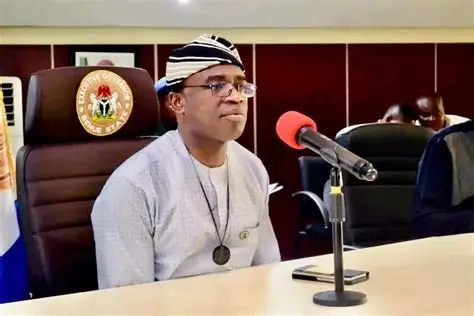
Benue State Governor, Hyacinth Alia, on Friday said his administration had begun implementing a 30-year development master plan aimed at ensuring that the state’s ongoing reforms and infrastructure projects survive changes in government.
Alia said the long-term plan was also designed to shield the state’s development agenda from vested interests and resistance from those benefiting from the existing system.
The governor spoke at a media parley at the Government House in Makurdi at the end of a three-day nationwide media tour of federal and state infrastructure projects led by the Special Adviser to the President on Information and Strategy, Bayo Onanuga.
Alia said his administration had faced resistance from people who questioned the value of its infrastructure investments and sought to preserve the status quo.
He said, “Reforms present a pushback from those who had enjoyed just a normal, same old status quo. ‘Don’t do this, it was not here, but we still lived and existed.’
“So would the Earth stop going round if we do them? The answer is no. But the status quo now becomes a problem.”
The governor also defended his administration’s infrastructure drive against arguments that projects such as roads did not directly benefit ordinary residents.
According to him, “Is it roads that we will eat? No, it is not roads that you will eat. But at the same time, intrinsically, you will enjoy the roads and you eat the roads, because they have gone through your farms, they have gone through the market square, and then from the produce on the farm, they are coming back to the buyer in the town or in some suburb area. So it means you are still eating the roads.”
Alia said Benue, which marked its 50th anniversary as a state this year, had never had a development master plan capable of providing continuity across successive administrations.
“Benue is 50 years old this year, and in those 50 years we’ve had a series of leaderships that came in and out.
“As a state, do we have a development master plan? The answer is no, we didn’t,” he said.
The governor said his administration had consulted residents to determine their development priorities rather than simply responding to demands from constituents.
According to Alia, “We had to go down to the trenches to ensure that this is what the market woman is needing, this is what the farmers are desiring, and this is what everybody in the state truly seeks to have, to take us from the so-called glorified village status to the proper status of a cityship.”
He added, “At Benue at 50, we began a 30-year master plan to ensure that even after power is changed, the same developmental dynamics are still kept, the same vision is being shared, and the same mission is being embarked upon through this developmental plan.”
Alia cited Lagos State as an example of how long-term planning could outlive individual administrations, recalling the transformation he said he had witnessed in the state over the years.
“This is how Lagos also began, and this is why I was highly enthused about President Bola Ahmed Tinubu becoming President.
“I had been there as a younger man many times. I knew what we went through, I knew how the city was, and in the last 25 years, the master plan that was made has been religiously executed,” he said.
The governor said the plan was intended to ensure that successive administrations would build on completed projects instead of repeatedly starting from scratch.
“If we have taken care of the primary healthcare, and we have already embarked on the secondary tier of the health system, subsequent administrations will have less concentration on those because they are fundamentally and diligently done in a manner that durability is guaranteed.
“This is why what we do is purely based on that durability of the thing a guarantee,” he said.
Responding to questions on the sustainability of projects such as the revived Taraku Mills factory and the Oju-Awajir road after his tenure, Alia said the government was using planning, community participation and private-sector partnerships to protect the investments.
He cited the collapse of the original Taraku Mills as an example of what could happen when public assets were treated as resources to be shared rather than protected.
“It’s quite unfortunate that we had lost Taraku Mills. That arm of commerce had died because people felt it was just a common cake, get your knife, cut a chunk, and then you leave. But at the end of the day, everybody lost,” he said.
Alia said the revived factory was being anchored on farmer cooperatives and private-sector partnerships to prevent a repeat of the circumstances that led to its earlier collapse.
He described resistance to change and the culture of underperformance as among the major challenges confronting his administration.
“You cannot keep doing one thing all the time and expect a different result.
“So we had a need to bring in reforms, and when you bring in reforms where there is so much drought of funds, drought of ideas, and drought of implemented projects on the ground, you really have to sweat, and you sweat bad.
“If you do not have to pay your child’s school fees for nine solid years, there is definitely some saving in there for you. Reforms are new, but if you give it patience, if you study it and look again at the differences, you come to realise that reforms are the way to go.”
Members of the Presidential Communications Team who participated in the tour of Benue included the Senior Special Assistant to the President on Media and Special Duties, Tunde Rahman; Senior Special Assistant to the President on Media and Publicity, Temitope Ajayi; and Senior Special Assistant to the President on Public Engagement, Frederick Nwabufo.
Others include: Senior Special Assistant to the President on Print Media, Abdulaziz Abdulaziz; Senior Special Assistant to the President on Strategic Communications, Linda Akhigbe; and Senior Special Assistant to the President on Digital/New Media and Social Media, Dada Olusegun, among others.
Read the full article here