





1
Julius Rone, Chief Executive Officer of UTM Offshore, says the company will move into the construction phase of Nigeria’s first Floating Liquefied Natural Gas (FLNG) project this year, even as he emerged The Sun Newspaper’s Investor of the Year.
He said if executed, will mark the most significant moment in Nigeria’s gas industry history.
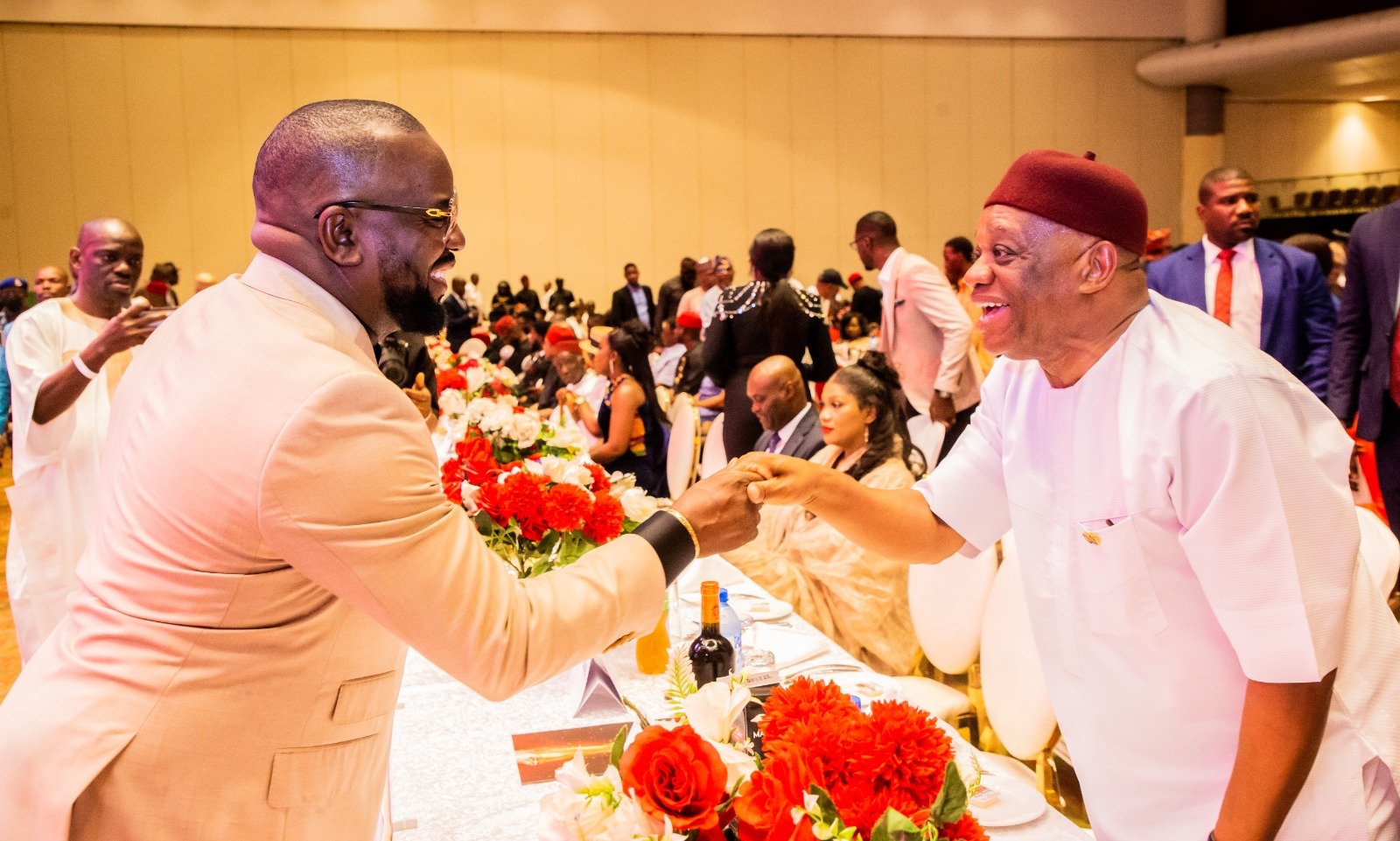
He made the declaration on the night The Sun Newspaper honoured him as its Investor of the Year 2026, an award that, in hindsight, could not have come at a more fitting time, stressing that he was there to announce that Nigeria’s first-ever Floating Liquefied Natural Gas (FLNG) project is about to get built.
“The administration of President Bola Ahmed Tinubu has continued to create an enabling environment to encourage investors, to tap into his Renewed Hope Agenda. The President has given lots of incentives to investors who want to develop the gas industry.”
It was a moment that spoke to something larger than one company or one project. For years, Nigeria’s gas sector has languished in the shadow of oil, its potential vast, its delivery frustratingly slow. Tinubu’s Renewed Hope Agenda, Rone suggested, is finally changing that calculus. And UTM Offshore is proof.
“We are quite pleased that our efforts are being recognised tonight, by The Sun Newspaper. For me, it is an encouragement to do more. Receiving this award tonight is quite an encouragement for us, and it will spur us to move the country forward from an investor’s point of view.”
At the heart of Rone’s ambition sits a project that reads like a blueprint for national transformation. “The UTM Offshore FLNG facility, positioned at the Yoho field within Oil Mining Lease 104, approximately 60 kilometres off the Niger Delta coast, is designed to produce 1.5 million tonnes of LNG annually for export and 300,000 tonnes of LPG for domestic consumption. Beneath it lies 2.2 trillion cubic feet of proven gas reserves, enough to sustain operations for two decades.
But it is the domestic story that cuts deepest. Nigeria has long carried the painful irony of being an energy-rich nation that imports cooking gas. Rone made clear that UTM Offshore intends to end that chapter.
“The project will improve domestic requirement for LPG in Nigeria. Instead of importing, we will be self-sufficient as a nation. One quarter of importation of LPG will stop, from this project, we will bring in at least 300,000 metric tonnes per annum to support the domestic market.
“We believe this project will bolster Nigeria’s economy, and will create a lot of employment for Nigeria and create revenue for Nigeria.”
“The financial architecture behind the FLNG project is, by any measure, formidable. UTM Offshore secured Afreximbank as lead financier, mobilising $2 billion for Phase One, with a further $3 billion already earmarked for Phase Two. Five billion dollars, committed to a single Nigerian-led energy venture. In a global financing landscape where large-scale energy projects routinely stall at the due-diligence stage, this is a statement of extraordinary investor confidence.
“The ownership structure reinforces it. NNPCL holds 20 percent, the Delta State Government 8 percent, and UTM FLNG retains 72 percent, a model that balances sovereign interest with the kind of private-sector agility that moves projects forward. It is, by design, a partnership built not just to start, but to sustain.
Behind the numbers and the partnerships is a career that spans decades of hands-on experience in Nigeria’s energy ecosystem. Rone’s professional journey, from OMPADEC to the Niger Delta Development Commission (NDDC), and eventually to the leadership of the UTM Group of Companies in 2008, is not that of a man who stumbled into ambition. It is the trajectory of someone who studied the terrain, built alliances, and waited for the right moment to move.
The project has engaged world-class international partners, JGC Holdings, Technip Energies, and KBR, and has undergone rigorous environmental and social impact assessments.
These are not cosmetic gestures. In a sector where public trust has historically been sacrificed on the altar of speed, they signal that Rone is building something designed to last.
When asked what drives a man to see a project of this complexity through to its end, Rone’s answer was disarmingly simple.
“The key principles for success are to be focused, hardworking and consistent,” he said.
Nigeria has never lacked for energy ambition. What it has lacked, painfully, repeatedly, is the will and the capacity to execute. The UTM Offshore FLNG project is, in every meaningful sense, a test of whether that changes.
The Sun Newspaper’s Investor of the Year award, in this light, is more than a recognition of what Julius Rone has already done. It is an early salute to what he is about to do. And if the Gas King delivers on the construction phase he just promised the room, 2026 could be the year Nigeria’s gas sector stops whispering, and starts roaring.
Read the full article here