






…Stakeholders Worry Over 90% Airports Are Not Self-Sustaining
…Say They Are Constructed Only For Political Reason
LAGOS – Two years after the Ekiti State Agro-Allied International Airport was commissioned by Dr. Kayode Fayemi, the former governor of the state, the airport is yet to take off despite the landing of the “maiden flight.”
Fayemi had commissioned the uncompleted airport on his last day in office on October 22, 2022, saying that the airport would drive economic traffic to the state.
The state government had said in 2022 that it would cost about N20 billion to construct the airport.
But two years later, nothing have been heard of the airport until on Sunday when the Nigerian Airspace Management Agency (NAMA) in a statement said it signed an agreement with the state government on the provision of air traffic services at the new airport.
Aviation stakeholders, who spoke with Daily Independent, said that the airport would only add to the number of growing unviable airports in the country.
Reports indicate that over 90 percent of Nigerian airports are not self-sustaining.
Most of them depend on the proceeds from the Murtala Muhammed Airport (MMA), Lagos; Nnamdi Azikiwe International Airport (NAIA), Abuja, and Port Harcourt International Airport (PHIA), Port Harcourt, to remain in business.
Some of the nation’s airports have only two flights daily.
In the last decade, no fewer than 10 state governments had muted or commenced new airport projects with most of them designated as ‘cargo airports.’
The governments of Osun, Ebonyi, Ogun, Benue, Zamfara, Nasarawa and Abia, all commenced airport projects, which never took off till date, but billions of naira were sunk into the ventures, which probably commenced without feasibility studies.
Fayemi had said that the airport, which is about 55 minutes drive by road to Akure airport in Ondo State, which started in 2019, when completed would act as a catalyst that would strengthen and boost the state’s economy, a claim which many aviation analysts doubted.
Speaking with Daily Independent, Engr. Oluwole Adebiyi queried construction of such airports in Ekiti, a neighbouring state to Ondo, which already had an airport.
Adebiyi insisted that rather than an airport project, the state government should have developed a multi-modal form of transport in the state that would connect it to other states especially Ondo for final transportation of agric produce to their final destinations.
He added: “What are the economic drivers of a cargo airport for Ekiti State and how much disposable income do Ekiti passengers have to justify the immense investment? Why not develop multi-modal means of transportation and leverage proximity to Akure. I hear it’s within five to 10 nautical miles.”
Mr. Olumide Ohunayo, the Director, Research, Zenith Travels, in a recent interview with Daily Independent, stated that the government never bothered with the financial implication of constructing an airport in the state.
He recalled that the idea of an airport for Ekiti State commenced with Mr. Babatunde Omotoba, as the minister in the sector in 2007, stressing that the minister had attempted to locate the project in Iyin Ekiti, his village.
He added: “Anyway, let them coat it with any name, cargo, passenger or even ad hoc, they should just look at Ilorin, Akure and Ibadan airports and tell us what they expect in future or the non-starter called Osogbo airport.”
Grp. Captain John Ojikutu, aviation analyst, explained that except Delta State with Asaba airport and good business plans before venturing into the airport business, many state governments constructed airports for political reason.
Ojikutu pointed out that out of the 27 airports in the country, six are state owned and private, while the remaining 21 are owned by the Federal Government.
He lamented that over 80 percent of these airports generated less than two million passenger traffic annually, noting that aside from Lagos airport with about five million passenger traffic annually, other airports in the South West with about 50 million population, the total passenger movement was less than 600,000 yearly.
He added: “So, what passengers would the Ekiti airport look for? What are the researches on agricultural and other cash produce that are available as cargo for transportation to other parts of Nigeria or for export from Ekiti and the other states agitating for cargo airports?
“What is the sense in the plan of the Anambra government to construct another airport in Awka that is less than an hour drive to Asaba and Enugu airports? The total passenger traffic at Enugu, Asaba and Owerri airports serving six states is less than two million and what passenger traffic would Anambra be looking at from this figure to justify its business plans?
“While Lagos State could have reasons to justify its planned second airport in the state because of its population and the stretch distances between its built up areas of Lekki and Epe to the Murtala Muhammed Airport (MMA), others should channel their resources towards other social amenities that would benefit the larger population of their states like health, education, roads and housing, among others.”
However, a statement by NAMA on Sunday said that as part of measures to ensure a seamless take off of the airport, the agency had signed a Memorandum of Understanding (MoU) with the Ekiti State government.
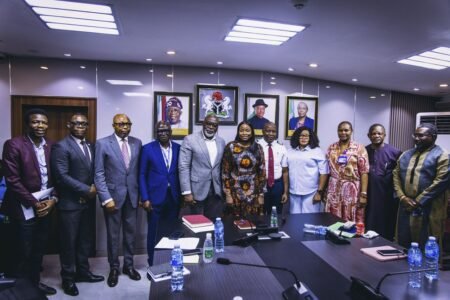
The statement by Stephen Onabe, Assistant General Manager, NAMA, said that the MoU was signed at the agency’s headquarters annex, Murtala Muhammed Airport, Lagos, over the weekend and attracted top officials of Ekiti State government as well as that of NAMA.
Engr. Farouk Umar, the Managing Director of NAMA, in his welcome address, said that the MoU represented a mutual commitment to excellence and “a shared dedication to delivering an exceptional result.”
According to him, the MoU outlined a joint responsibility, expectation and standard for air traffic control services, adding that the event also served as a foundation for a partnership between NAMA and the Ekiti State government.
Farouk, who was represented by Mrs. Isemiuhonmon Egbadon, Director of Legal Services and Company Secretary, NAMA, maintained that the MoU was more than a contract.
Also in her remarks, Dr. Habibat Adubiaro, the Secretary to Ekiti State Government, who represented the state governor, noted that the event marked a crucial moment as the state advances towards enhancing the safety, efficiency, and reliability of airspace and air traffic management.
She assured that the airport was on the verge of full operation.
Read the full article here