




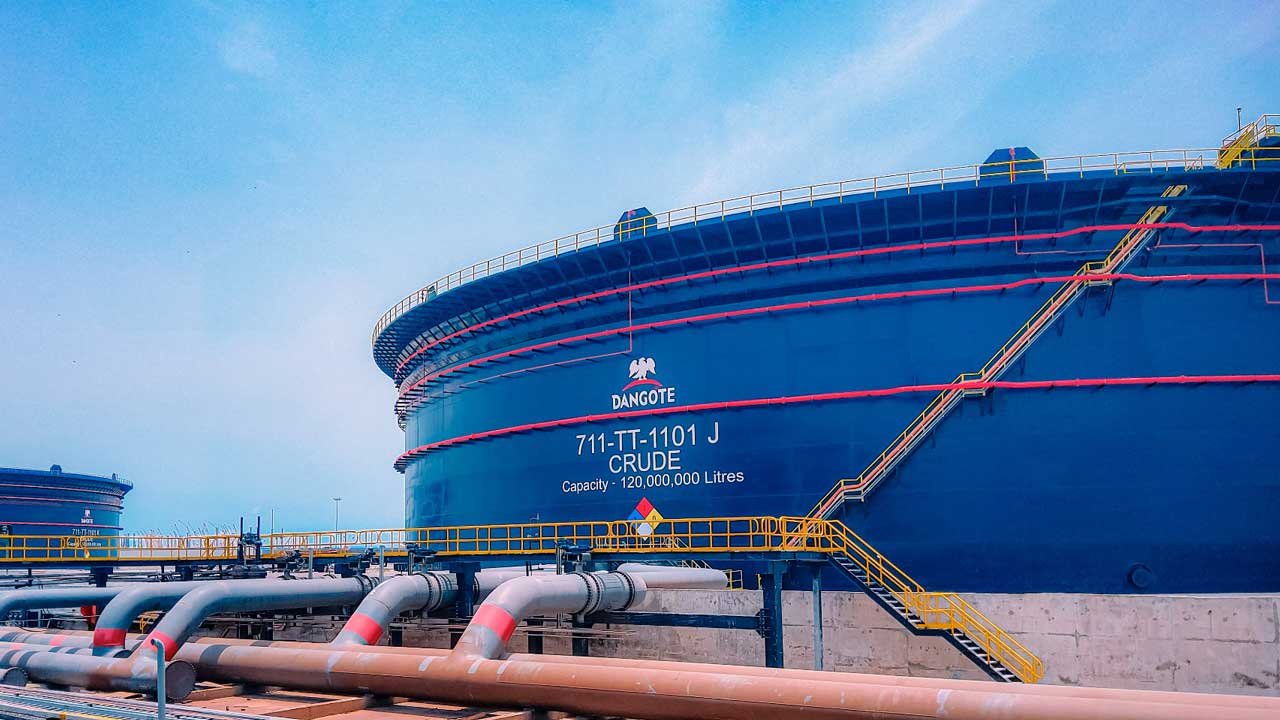
The Nigeria Union of Petroleum and Natural Gas Workers (NUPENG) threatened a nationwide strike beginning Monday, 8 September, in protest against what it described as anti-union practices by the Dangote Petroleum Refinery.
At the heart of the dispute is the refinery’s decision to deploy 4,000 new Compressed Natural Gas (CNG) trucks for direct distribution of fuel while allegedly asking drivers to shun union membership.

The refinery’s new logistics model, unveiled in June, is poised to reshape Nigeria’s downstream sector. But it has also pitched one of Africa’s richest men, Aliko Dangote, against one of Nigeria’s most powerful unions, raising questions about workers’ rights, monopoly fears, and the changing balance of power in the country’s petroleum industry.
In a statement after its national executive council meeting last week, NUPENG accused the refinery of “flagrant violation of workers’ constitutional rights to freely associate” and vowed to mobilise its members to resist.
“Dangote is discarding drivers who toil day and night, while seeking to silence them,” said Olawale Afolabi, NUPENG’s national secretary. “They don’t want the workers to have any voice or representation.”
The President of the Petroleum Products Retail Outlets Owners Association of Nigeria (PETROAN), Billy Gillis-Harry, also said the action of Dangote may “push smaller operators and truck owners out of business” and tilt the market toward monopoly.

The union’s strike notice, however, has not gained unanimous backing. The Petroleum Tanker Drivers (PTD) branch, which traditionally is one of NUPENG’s most influential arms, urged its members to ignore the directive, describing it as “insensitive and unacceptable.”
“This is a clarion call to all Petroleum Tanker Drivers across Nigeria to please ignore the strike notice,” PTD leaders said in a Friday statement. “Any action against the smooth flow of petroleum products in the country is a disservice and an abuse of the power of unionism.”
Similarly, the Direct Trucking Company Drivers Association (DTCDA) distanced itself from the strike, calling it “a disservice to Nigerians.”
Dangote’s new fuel order
In June, the Dangote Refinery announced it would begin direct distribution of Premium Motor Spirit (PMS) and diesel to filling stations, manufacturers, aviation companies, telecoms, and other bulk consumers.
The programme was backed by 4,000 CNG-powered trucks, new distribution hubs, and “daughter booster stations” for rural and underserved areas. It also includes a credit scheme: buyers who lift 500,000 litres of fuel can obtain another 500,000 litres on two weeks’ credit, backed by a bank guarantee.
The refinery says the goal is simple: reduce logistics costs (which currently account for 10–30 per cent of pump prices), promote cleaner energy, and stabilise supply across Nigeria.
Analysts say the initiative could lower fuel costs and ease inflationary pressures in the short to medium terms. But others warn that the aggressive rollout could stifle the operations of private depot owners, modular refiners, and independent marketers.
PETROAN warned that Dangote’s market dominance could result in a pricing strategy that initially lowers prices to gain market share but may subsequently lead to increased prices, with potential disadvantages to consumers in the long term.
The Nigeria Labour Congress (NLC) has backed NUPENG. Its president, Joe Ajaero, accused the Dangote Group of “exploiting Nigerian workers while disregarding their constitutional rights.”

“We call on the president to immediately call Aliko Dangote and Alhaji Sayyu Dantata to order,” Mr Ajaero said. “The government must not look the other way while a few individuals privatise the nation’s energy future and enslave its workforce.”
Dangote Group Chief Branding and Communications Officer, Anthony Chiejina, told this newspaper last week that “Dangote is creating job for 8,000 people that is suppose to be roaming the street of Nigeria and anybody can wake up and claim that he said this or that meanwhile he didn’t say such.
“These people, they know that when these things kick in, all the monetary benefit they used to get before won’t be there again. That’s their pain.”
In its response, the PTD also argues that NUPENG is simply trying to protect a decades-old chokehold on petroleum distribution that Dangote’s model now threatens to dismantle.
NUPENG before Dangote
For decades, NUPENG has been one of Nigeria’s most influential workers unions. Its members — tanker drivers, depot workers, and oil staff controlled the movement of transported fuel across the country.
That control translated into immense leverage. Any strike or work stoppage could paralyse the economy overnight, causing fuel queues, soaring transport fares, and food inflation.
During the military years, NUPENG was more than a labour body. It became a political force, aligning with pro-democracy activists and staging crippling strikes after the annulment of the June 12 1993 election. Union leaders were detained, proscribed, and sometimes jailed, but their actions helped weaken military rule.
Even in the democratic era, NUPENG’s threats of strikes over wages, subsidies, and government policies forced hurried concessions. Alongside PENGASSAN, the senior staff union of Petroleum and Natural Gas workers, it wielded a “double strike” power: halting both oil production offshore and fuel distribution across the country.
But the rise of the Dangote refinery threatens that leverage. For the first time in decades, Nigeria has a private, integrated refining and distribution system that could bypass the union’s chokehold.
What the law says
Nigeria’s laws and international commitments guarantee workers’ rights to organise and freely choose their unions.
Section 40 of the Constitution upholds the right to assemble and associate, while the Trade Unions Act affirms the right to form and join unions.
In addition, Section 9(6) of the Labour Act prohibits employers from forcing workers to either join or refrain from joining a union. The country has also ratified International Labour Organisation (ILO) Conventions 87 and 98, which protect freedom of association and the right to collective bargaining.
Labour law analyst Yinka Chukwuemeka Ogunnubi says both NUPENG and Dangote are walking a fine line. He explains that while Dangote’s alleged insistence that 4,000 new truck drivers sign undertakings not to join unions violates Section 40 of the Constitution, Section 9(6) of the Labour Act, and ILO conventions ratified by Nigeria, NUPENG’s push to force union membership equally infringes workers’ constitutional freedom of association.
According to Mr Ogunnubi, NUPENG retains the right to strike but must strictly follow procedures laid down in the Trade Disputes Act, including mediation, arbitration, and lawful strike notice. Otherwise, the planned nationwide strike risks being declared illegal.
“The law provides enough room for both parties to resolve their differences through the proper dispute mechanisms,” Mr Ogunnubi said, warning that ignoring due process risks pushing the country towards lawlessness.
The courts have already affirmed that multiple unions can operate in the same sector.
In October 2022, the Nigerian government registered the Congress of University Academics (CONUA) and the National Association of Medical and Dental Academics (NAMDA), despite opposition from ASUU.
The Industrial Court upheld their registration, ruling that the plurality of unions is lawful.
By extension, workers at Dangote Refinery can freely choose whether to join NUPENG, a new association, or none at all. Membership is voluntary, according to the court ruling.
READ ALSO: NARTO backs NUPENG, accuses Dangote of monopolistic practices
But the standoff between Dangote and NUPENG is more than a labour dispute. It speaks to a deeper shift in Nigeria’s energy landscape from a union-dominated, import-dependent system to a private-led refining and distribution model.
Economic analyst Paul Alaje warns that while Dangote’s initiative may initially stabilise fuel supply and lower prices, there are inherent risks.
“If Dangote were to transition to dollar-based sales due to crude supply issues — as happened in March when naira-based sales were suspended — pump prices could rise sharply,” Mr Alaje said.
“That would push up transport and production costs, worsening inflation and eroding the expected benefits for ordinary Nigerians.”
For ordinary citizens, the stakes are high. If NUPENG embarks on strike actions, fuel queues and black markets may return. If Dangote dominates unchecked, smaller players could vanish, raising fears of monopoly pricing.
As both sides dig in, analysts say the challenge for the government is to uphold workers’ rights, ensure fair competition, and prevent a showdown that could once again hold Nigerians hostage at the pumps.
Read the full article here