






1
In Nigeria’s complex development narrative, few projects in recent memory have ignited as much hope, debate, and anticipation as the Lagos–Calabar Coastal Highway. Stretching over 700 kilometers and cutting across seven coastal states, including those in the historically marginalised Niger Delta, the highway represents more than a civil engineering feat. It symbolises a turning point for host communities, especially in the oil-rich but infrastructurally impoverished Niger Delta, where decades of environmental degradation, economic exclusion, and political neglect have long stifled progress.
According to President Bola Ahmed Tinubu, the Lagos–Calabar Coastal Highway is “a corridor of hope, unity, and prosperity.” For Niger Delta communities, that corridor may finally be the gold mine they have long waited for, not in oil, but in opportunity, access, and economic rebirth.
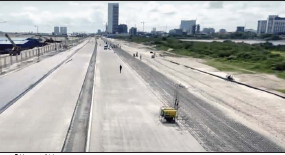
Launched officially in March 2024, the coastal highway is designed not just as a road but as a strategic economic artery. By connecting Lagos to Calabar and passing through Ogun, Ondo, Delta, Bayelsa, Rivers, and Akwa Ibom states, the road creates a direct economic spine across the southern corridor. For the Niger Delta, particularly states like Delta, Rivers, and Bayelsa, the project promises to unearth latent value long buried under poor connectivity.
Already, the highway is generating employment at a scale previously unseen in the region’s infrastructural projects. Conservative figures from the Federal Ministry of Works estimate that over 10,000 direct jobs have been created, with another 15,000 indirect jobs across ancillary services such as logistics, security, food supply, and transportation.
According to Engr. David Umahi, Minister of Works, “This is not just a road project. It is an economic revolution. Every kilometer of this road is creating jobs, empowering communities, and triggering investment.”
One of the project’s most under-reported benefits is human capital development. Construction firms working on the highway have been mandated to employ and train locals. In Delta and Rivers states, thousands of young people are undergoing on-site training in construction, welding, surveying, and heavy machinery operations.
“The skills I’ve learned in the past three months have changed my life,” said Ebiowei Johnson, a 27-year-old from Bayelsa undergoing training in civil works. “Before this project, I was jobless. Now, I have skills that can feed me and my family for life.”
By equipping youths with practical, high-demand skills, the highway is quietly laying the foundation for a locally-driven industrial base. This has long-term implications for employment, entrepreneurship, and reduced youth restiveness in the region.
The Niger Delta is rich in resources, fertile soil, abundant seafood, and a strong tradition of fishing and small-scale farming. However, lack of transport infrastructure has for decades limited these communities to subsistence-level trade.
Dr. Rose Wokocha, an agricultural economist stated: “With improved access to markets in Lagos, Port Harcourt, and Calabar, we anticipate a 20–30% increase in rural incomes through reduced post-harvest losses and lower logistics costs.”
This means that farmers in Oron (Akwa Ibom) or fishers in Bonny (Rivers State) will no longer rely solely on middlemen or local markets. They can now participate directly in regional supply chains, boosting their earnings and increasing food availability for urban centers.
Perhaps the most immediate gold mine for host communities is tourism and real estate. The Niger Delta boasts breathtaking landscapes, mangrove forests, estuaries, and virgin beaches. With enhanced road access, the region becomes a tourism magnet.
Bishop Jonas Katung, Chairman of the Northern Pentecostal Bishops Forum, underscored this point: “The Lagos–Calabar Highway will boost the tourism sector and increase the volume of trade along the coastal line. It will open so many communities and attract foreign investors.”
Already, local governments in Akwa Ibom and Cross River have begun drafting tourism promotion plans to leverage the corridor. In Eket and Calabar, real estate prices have surged by over 25% since the highway’s announcement.
Urban developers like Chuks Obi, CEO of FastBuild Africa, are optimistic: “We see this as a trigger for a housing boom. Resorts, gated estates, and service apartments are in the pipeline. This project is opening a new frontier for real estate development.”
For many remote communities in the Niger Delta, reaching hospitals or schools has historically involved canoe trips or hours on rough terrain. The new road promises to change that by connecting these communities to service centers in record time.
Mrs. Ijeoma Omoregbe, a midwife in Burutu, Delta State, remarked: “Some women used to give birth at home or on the way to distant clinics. With this road, access to health care will improve drastically.”
Women, children, and elderly residents, often the worst hit by poor infrastructure—stand to benefit enormously from better mobility. Whether for commerce, education, or health, the highway is turning isolation into integration.
The project is a major enabler for Nigeria’s nascent blue economy, a term encompassing maritime trade, fishing, aquaculture, and coastal tourism. With modern infrastructure, fishing communities will gain better access to cold storage facilities and distribution networks.
A policy paper from the Federal Ministry of Marine and Blue Economy suggests that the Lagos–Calabar Highway could add $3–5 billion annually to Nigeria’s GDP through enhanced maritime activities and tourism.
As gathered by DAILY INDEPENDENT, “This project is a gateway to the blue economy. With the integration of ports, rail lines, and inland waterways, Nigeria will finally begin to tap into its $100 billion maritime potential.”
Critics initially raised concerns about the highway’s environmental impact. In response, the Federal Government launched a comprehensive Environmental and Social Impact Assessment (ESIA) in partnership with international consultants and local community leaders.
According to Minister Umahi, “We have rerouted certain sections of the road to protect sensitive ecosystems and cultural sites. Green zones and reforestation programs are part of the design.”
The highway’s integrated rail line is a key component in reducing emissions, providing a low-carbon alternative for moving goods and passengers. Combined with future plans for electric vehicle lanes, the Lagos–Calabar Highway could become a model of green infrastructure in Africa.
More than any infrastructure project in recent memory, the Lagos–Calabar Coastal Highway is a blueprint for inclusive development. It shows what is possible when government policy, private sector investment, and community interests align.
Dr. McCarthy Ijiebor, an infrastructure policy analyst, captured the essence: “This highway is a model. If executed transparently, with community-friendly tolling and local content, it can be a win-win for all stakeholders.”
Even critics are beginning to come around. International bodies like the African Development Bank (AfDB) have expressed interest in supporting associated developments along the corridor, especially in transportation and logistics.
The Niger Delta has been a paradox, rich in oil but poor in development. For decades, it has borne the brunt of environmental exploitation without commensurate compensation or investment. The Lagos–Calabar Coastal Highway is a chance to correct that historical injustice.
“It’s not just about cement and bitumen,” said Chief Tolani Oladipo, a businessman and community leader. “This road is restoring dignity. It is giving us a reason to hope again.”
Estimates project that the highway will contribute over $45 billion to the Nigerian economy within its first five years. For host communities, this is more than infrastructure, it is a lifeline, a rebirth, and a chance to rewrite their future.
Nigeria has embarked on an ambitious journey, and the Lagos–Calabar Coastal Highway is both literal and symbolic of that path forward. For the Niger Delta, it is a gold mine not of minerals, but of opportunity, inclusion, and economic justice.
If the government maintains its current pace and integrity, and if host communities are actively included in every phase, this project could stand as the greatest infrastructural legacy of this generation.
As one local trader in Warri put it, “This road na our own oil well. But this one go benefit everybody.”
Indeed, the road ahead, quite literally, looks promising.
Read the full article here