




In the long, fraught genealogy of African protest poetry—from the Okigboan fragmentation to the caustic urbanity of Ojaide’s Niger Delta elegies—there emerges with striking clarity a voice that has laboured for nearly four decades in relative obscurity, only now to arrive with the cumulative force of a prophecy long deferred.
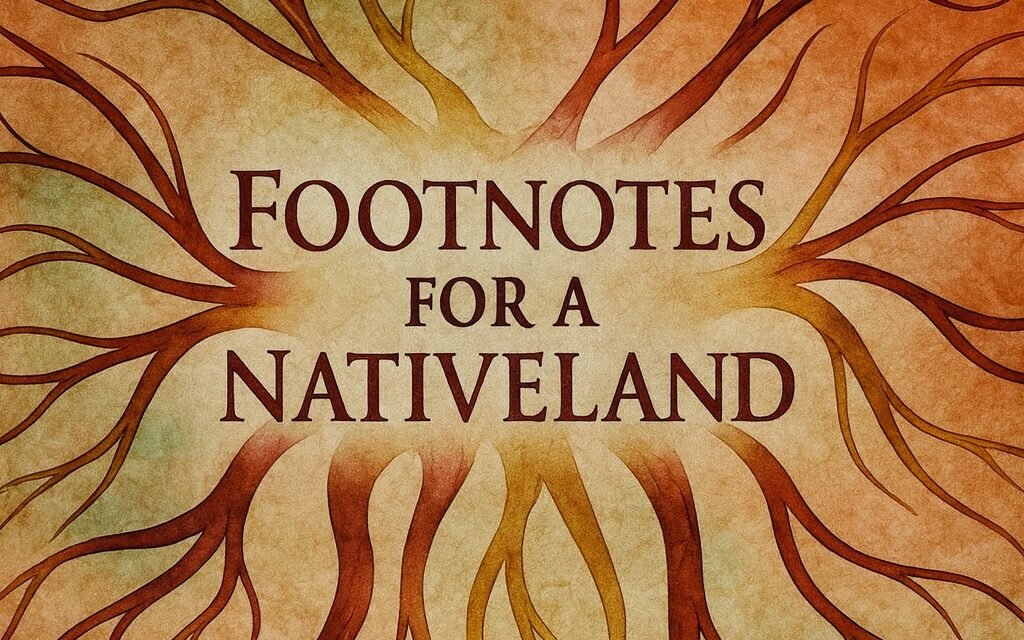
Emman Usman Shehu, the Nigerian poet whose career spans from the military-era defiance of QUESTIONS FOR BIG BROTHER (1988) through the metaphysical reckonings of ICARUS RISING (2017) and the riparian meditations of THE RIVER NEVER RETURNS (2022), has produced with FOOTNOTES FOR A NATIVE LAND a work that consolidates his standing as one of the most systematic and uncompromising chroniclers of the Nigerian condition writing today.
Published in February 2026, this fifth collection arrives at a moment when Nigeria’s compound crises—economic precarity, environmental catastrophe, state violence, and a haemorrhaging of its human capital—seem to demand a poetic response adequate to the scale of the disaster.
Shehu answers not with the hermetic ironies of late-modernist withdrawal, nor with the easy comforts of Afro-optimist branding, but with something far more difficult: a scripture of the ordinary, an epic of the overlooked.
The collection’s governing conceit is announced with deceptive modesty. Sixty-two poems (including the sequence “Down to the Refrain” and the closing “Nunc Dimitis”) are figured as footnotes—the apparatus of scholarly and legal discourse, the fine print that confirms or subverts the main text. Shehu inverts this hierarchy with the force of a political manifesto.

The “main text,” in his accounting, is the official narrative of the Nigerian state: the communiqués from Aso Rock, the padded budgets, the National Broadcasts delivered from marble halls. The footnotes, by contrast, are the lived realities that this official story is designed to obscure: the calloused hand of the bricklayer, the “stolen dawn” of the ten-year-old hawker, the fisherman’s net returning heavy with crude and light with tilapia.
This is a sophisticated and internally coherent aesthetic programme. Chioma L. Enwerem, in a capacious foreword, rightly identifies the collection’s central gesture as “poetic reclamation,” and Shehu executes it with remarkable formal consistency across the book’s four loose movements.
The first, comprising poems 1–19, traces an arc from silence to utterance—from the “tethered tongue” of “Elder’s Gaze” and the “kolanut’s red ancestral eyes” that “bind my voice / to the circle’s ancient will” in “Beneath The Kolanut’s Weight,” through the slow, tectonic rebellion of “Stir of the Harmattan” and “Cracks in the Baobab’s Skin,” to the triumphant communal chorus of “Dance of the Unbound Tongue” and “Chorus of the River’s Mouth.”
This is the collection’s most formally achieved sequence, and it bears comparison to the mythopoetic architecture of Okigbo’s HEAVENSGATE or the ritual progressions in Soyinka’s IDANRE, though Shehu’s register is decidedly more vernacular and his politics more explicitly materialist.
The opening poem, “Palmwine For Elusive Eyes,” serves as an ars poetica of remarkable clarity. Shehu explicitly rejects the Western classical tradition—”I call you / not from distant Olympus”—in favour of an autochthonous muse drawn from the “pulse of this ancient soil,” from the “Niger’s bend, the Benue’s embrace.” This is not merely nativist posture.
Shehu’s muse is synesthetic and deeply embedded: she winks “from the curve of a danfo’s horn,” hides “in the rhythm of talking drums,” stirs “in the spice of suya smoke rising / over flickering lanterns.” The poem’s achievement is to ground the act of poetic making in the sensorium of everyday Nigerian life without sacrificing lyric intensity.
“Kiss the Truth,” which follows, extends this programme with a daring extended metaphor. Here the muse is a trader in the Kantin Kwari market, “haggling for the price / of a metaphor,” her wrapper “tucked firm against the Harmattan’s tongue.” She demands not facile beauty but “the scent of diesel / and the salt of sweat, / the jagged truth of the morning headline.”
The poet, rejected for offering too-thin ink, must “sharpen my stylus / with the edge of a hunger.” This is a poetics of materialist witness that refuses the consolations of the aesthetic. As Shehu puts it in the poem’s closing lines, “to woo the muse / is to woo the storm.”
The collection’s second movement (poems 20–39) constitutes its most ambitious undertaking: a systematic mapping of Nigeria’s dual environmental catastrophe across the North-South axis. “Two Tongues of the Earth” (poem 39) is the theoretical centrepiece, a bravura comparative meditation that finds uncanny symmetry between the Niger Delta’s oil toxicity and the Sahara’s southward advance.
Shehu’s imagery is arrestingly precise: the Delta’s “black gold” becomes a “liquid poison that chokes the silver fish,” while the northern dunes are a “granular ghost that strangles the baobab.”
“Both,” he concludes, “are tongues of a fire that leaves the belly empty.” The poem’s closing couplet—”how do you survive when the North is a parched throat / and the South is a poisoned lung?”—distills the nation’s condition into a single, devastating figure of respiratory distress.
The Delta poems are among the collection’s most viscerally affecting. “Thirst of the Creek” opens with a description of gas flares as “a second sun, a jagged orange tongue licking the sky,” a conceit sustained with chilling control. The “national cake,” Shehu observes, is “baked in our backyard, yet the only part we receive / is the soot in our lungs.” “Fisherman’s Empty Net” sustains a funereal tone through a tight ballad-like structure, its ABAB couplets accumulating the weight of elegy: “His net returns with oil, not fish; / the river’s heart a poisoned wish.”
The Mokwa flood sequence (poems 31–37) represents Shehu’s most sustained engagement with the politics of infrastructure and state neglect. In “Mokwa Weeps,” the poet insists that “the rains are not to blame,” directing his indictment instead toward “the hands that felled the forests, / that paved floodplains with concrete greed, / that choked drains with refuse and neglect.”
This is not the anti-pastoral of Romantic disillusionment; it is forensic ecopoetics, a poetry that names culprits and demands accountability. The drowned speak in “The Drowned,” a remarkable prosopopoeia in which the two hundred-plus victims of the 2024 floods become choric witnesses: “We are the drowned, but not the gone. / Our voices ripple in the rain, a chorus for the living.” Shehu’s risk of ventriloquizing the dead is mitigated by the political precision of his accusation: the floods are “not by nature’s whim alone / but by the hands that failed to act.”
If the first movement traces a trajectory from silence to speech, and the second maps ecological devastation, the third (poems 20–30 and 38–39) assembles a gallery of labouring figures that constitutes a kind of counter-census of the Nigerian working class. “Toiling Bones” and “The Sun Chews Their Bones” are the most overtly polemical poems in the collection, their rhetoric sharpened to the edge of agitprop.
The latter opens with a personification of the sun as “a tyrant [that] gnaws their spines,” an image of cosmic hostility that Shehu extends to encompass the entire political economy: “Native-land your warmth is cruel, / a furnace fed by the worker’s fuel.”
Yet Shehu is at his best when he moves beyond generalised indictment toward the particular. “Stolen Dawn,” a portrait of a ten-year-old hawker, achieves a specificity that is devastating precisely because it resists sentimentality. The child’s inventory—”Buy gyada, buy zobo, buy pure water!”—becomes a litany of diminished possibility, and the detail of the Emir’s palace that “looms so grand / but casts no shade on her small hand” is a masterclass in imagistic compression.
“The Maid’s Silent Scream” and “Barren Scroll” extend this focus to the domestic worker and the unemployed graduate, figures whose invisibility in official discourse is mirrored by their marginal position within the national imaginary.
“Iron in the Marrow” (poem 30) is in many respects the collection’s most accomplished single poem. A sustained tribute to the Nigerian market woman, it deploys a free-verse line of extraordinary suppleness, moving from the domestic intimacy of the mortar’s “steady thud-thud that beats back the shadows” to the macroeconomic scale of “the men in the high towers of glass / debating the macro and the micro of the ruin.”
Shehu’s central metaphor—the woman as “silent cartographer of the kitchen, / mapping out how to stretch a mudu of garri / into a bridge that will carry five souls across the week”—achieves an intersection of domestic labour and national crisis that recalls the best work of the Caribbean poet M. NourbeSe Philip. The poem’s closing image of women who “held the sky up with a single tired shoulder” is a resonant tribute that earns its grandeur through the accumulated specificity of the lines that precede it.
The fourth movement (poems 40–62) extends the collection’s gaze to the formal political sphere, with uneven but often striking results. “Oath of Hollow Tongues” is an ambitious deconstruction of the national pledge that implicates not only the venal political class—”leaders with bellies swollen like gods”—but also a citizenry complicit in its own subjugation. “We curse the leaders,” Shehu writes, “but mirror their sins, / our silence a rope tightening around hope.” This willingness to indict the oppressed alongside the oppressor gives the collection a moral complexity that distinguishes it from more straightforward protest poetry.
“Poem for a Flag” (poem 57) is the collection’s most structurally ambitious political poem, a prosopopoeia in which the Nigerian flag itself becomes a speaking subject. The device risks bathos—one recalls the many failed personifications of national symbols in postcolonial verse—but Shehu controls it with assurance.
The flag’s memory of hope—”hoisted high in ’60, when hope was a river flowing free”—gives way to a litany of betrayals: “my green is mocked by barren lands, / where oil spills poison the Niger’s pulse.” Yet the poem refuses to settle into pure lament, pivoting instead toward a qualified optimism: “I am no mere cloth, no rag of regret. / I am the soul of a giant, chained yet fierce.
“A Land That Drinks Its Blood” (poem 56) is perhaps the collection’s most ambitious formal experiment: a polyphonic invocation of ancestral spirits from Nigeria’s four cardinal regions, each crying out against the nation’s self-immolation.
The Eastern ancestors invoke “Ọdịnani,” the Western elders call upon “Ṣàngó” and “Orunmila,” the Northern ancestors speak through Daurama, the legendary founder of the Hausa states, and the Delta ancestors mourn the desecration of their mangroves. The effect is incantatory, almost oratorio-like, and it demonstrates Shehu’s capacity to weave a distinctly Nigerian spiritual vocabulary into his contemporary political critique without lapsing into ethnographic display.
Shehu’s formal register is predominantly free-verse, but he deploys a range of prosodic strategies with considerable skill. The early poems favour short, enjambed lines that enact the constriction they describe—”my tongue lies tethered, / a riverbed stone”—before opening into longer, more flowing cadences as the voice achieves liberation. The political poems often employ ballad-like quatrains (“Ghosts of the Hammer”) or irregular syllabics that recall the prophetic free verse of Christopher Okigbo and the more declarative mode of Jared Angira.
“Down to the Refrain” (poem 61), a sequence of ten lyric fragments, is the collection’s most formally adventurous piece. Each section repeats the incantatory phrase “not far from here” and the choral refrain “down to the refrain / floating in the air,” creating a musical structure that mirrors the act of memory itself. The sequence moves from the intimate—”she pressed groundnuts into my palm”—to the diasporic—”now replaced by snow”—to the elegiac—”the funeral where no one dared sing the song he loved most.”
The final section, in which children’s fingers pluck “three wrong notes” on “the same old guitar,” introduces a note of qualified hope: “they will reach into the vault of memory / bringing back this moment / right now / still being lived.”
The closing poem, “Nunc Dimitis,” is a sequence of nine short meditations on naming, framing, and the weight of words that builds toward a metaphysics of language. “Words build the cage,” Shehu writes, “slow, unhurried / long before the bars are seen.” The poem’s title—the Canticle of Simeon from the Gospel of Luke, traditionally sung at Compline—suggests a valediction, a release. Yet the final section resists closure: “a whisper / holds the weight / eternal / in its pause.”
This ending, with its gesture toward the ineffable, represents a significant departure from the collection’s generally declarative mode, and it may disappoint readers who expect a more programmatic conclusion. It may also, however, signal the direction of Shehu’s future work: toward a poetry that acknowledges the limits of witness even as it insists on its necessity.
No review of FOOTNOTES can avoid the question of its readership. At nearly ninety pages, with a glossary presumably aimed at non-Nigerian readers, the collection positions itself for international circulation even as its referents remain stubbornly local.
Shehu’s poetry is dense with toponyms (Mokwa, Kofar Mata, Obalende, Kantin Kwari), cultural practices (the kolanut ritual, the koroso dance), and political references (EndSARS, Lagdo Dam, the Iva Valley massacre) that may resist easy comprehension by readers unfamiliar with the Nigerian context.
This is simultaneously the collection’s greatest strength and its most significant limitation.
The specificity of Shehu’s witness is what gives his poetry its moral authority; these are not poems about “Africa” as an abstraction but about Nigeria as a lived reality, documented with the fidelity of a chronicler. Yet the density of local reference may, in the international literary marketplace, prove a barrier to the recognition the collection deserves.
One thinks of the rhetorical strategies of Seamus Heaney, who managed to make the particularities of Mossbawn and the Bog People legible to a global readership through the mythopoeic frame. Shehu’s frame is less accommodating: he demands that the reader enter his world on its own terms.
FOOTNOTES FOR A NATIVE LAND is not an easy collection. It is angry, occasionally didactic, and unapologetically partisan. Its poems sometimes sacrifice ambiguity for clarity, nuance for moral urgency. Shehu’s commitment to the declarative mode—the poem as indictment, as witness, as testimony—occasionally flattens the complexity that his better work achieves. The collection’s structure, while coherent, occasionally feels schematic, and some of the later political poems (“Same Old Creed,” “This Is How They Show Us Love”) read as sketches rather than fully realised works.
Yet these limitations are, in a sense, intrinsic to the project Shehu has undertaken. This is poetry that refuses the consolations of aesthetic distance, that insists on its own embeddedness in the crisis it describes. At its best—in “Iron in the Marrow,” in “Kiss the Truth,” in “Mokwa Weeps,” in “Down to the Refrain”—it achieves a fusion of lyric sensitivity and political acuity that places it in the first rank of contemporary African poetry in English.
One is reminded of the late Kenyan poet and critic Austin Bukenya’s formulation: that the postcolonial poet must be at once “a singer and a surgeon.” Shehu, across a career of nearly forty years and five collections, has steadily refined this double vocation. FOOTNOTES FOR A NATIVE LAND is his most complete statement to date—a work that documents the wounds of a nation even as it insists, with the fierce and unyielding spirit that animates its finest poems, on the possibility of healing. The footnote, Shehu demonstrates, has become the main text. We ignore it at our peril.
(Emman Usman Shehu. FOOTNOTES FOR A NATIVE LAND.Abuja: Topaz Books, 2026. 87 pp. ISBN: 978-978-68-4936-2)
***
Sully A. Atung is a freelance contributing editor.
Read the full article here