







At the fourth edition of CHINET Aviacargo Conference held in Lagos last week, experts in the cargo, aviation and insurance sectors, spoke on the chains of challenges limiting the growth of export, aircraft operations and insurance cover for airplanes in the country. They also advised the government and private investors on the way forward. OLUSEGUN KOIKI writes.
Nigeria’s export cargo generally is disrupted and unorganised. Most of the goods taken out of the country are rejected and deemed lower to international standards. In fact, most are not traceable.
Some exporters who entered the business with millions of dollars, have got their fingers burnt. Many of the country’s agric producethat are lucky to get out of Nigeria, are freighted to Europe, Asia and America through neighbouring African countries who re-package them and distribute them appropriately.
At present, Nigeria hardly earns forex from agricultural produce as ships and freight aircraft depart the country empty.
The exporters said that a vibrant agricultural sector would create jobs and increase government revenues through taxes, levies, and tariffs, while the economy cumulatively receives a boost.
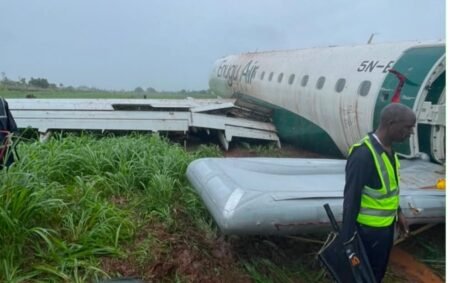
Also, the controversial aircraft insurance gained traction as aviation and insurance experts shared their experiences on the capacity of the indigenous insurance firms to properly insure aircraft for local operators.
These formed part of discussions at the fourth edition of CHINET Aviacargo Conference held in Lagos over the weekend with the theme: ‘e-Commerce and the Future of Air Cargo in Africa: The Building Blocks,’ organised by Mr. Ikechi Uko, the organiser of the event.
Otunba Frank Ogunojemite, President, Africa Association of Professional Freight Forwarders and Logistics of Nigeria (APFFLON), in his presentation, ‘Challenges of Export at Nigerian Airports,’ mentioned cost of aircraft and maintenance, high cost of freight, poor incentives and government’s quality of regulations, deficiency of cargo security and technology as some of the constraints affecting air cargo business in the country.
Other challenges according to Ogunojemite are harassment, extortion by law enforcement agencies, climate change, multiple taxation, bureaucracies and protocols.
To drive growth in the sub-sector, he canvassed for review and enforcement of a smoother process on export by the government and its agencies.
He declared that it was obvious that Nigeria was the one holding itself down from taking advantage of the huge market in the country, stressing that Nigerian farm produce and other products from the country were in high demand from different parts of the world.
He insisted that for Nigeria to benefit maximally from the African Continental Free Trade Area (AfCFTA) agreement, it had to be adequately prepared to effectively compete in export trade.
He added: “Experts had disclosed that for this to be achieved, there must be effective distribution channels in which logistics, which is movement of people and goods, play an indispensable role of bridging the gap between the dream and its reality.
“Most of these challenges will continue to exist until every agency of government will consciously aim at helping to mitigate and resolve some of these issues, and not seeing themselves as being up there, while every other person is down beneath.”
To address the challenges, he called for improved infrastructure, automation and digitalization, efficient customs processes, capacity building, regulatory framework, competitive pricing and the involvement of private investors in the cargo business, among others.
Mr. Olusegun Ayo Omosehin, the Commissioner for National Insurance Commission (NAICOM), speaking on insurance capacity and aircraft insurance, debunked the claim that insurance companies in Nigeria lacked the capacity to successfully insure aviation business, especially aircraft acquisition.
He also said the resort to re-insurance was in line with global best practices, where all underwriters had existing treaties with re-insurance companies.
Omosehin, further reiterated that the insurance companies in the country had the capacity to insure all aspects of the aviation industry, including airlines, cargo, catering and others.
According to him, there were no fewer than 29 aviation underwriters in Nigeria regulated by NAICOM in compliance with the regulations of the Nigeria Civil Aviation Authority (NCAA).
He assured operators not to panic, that their risks were being insured in Nigeria.
He said: “We ensure the stipulated standards are met. Every year, by January, we review the reinsurance treaties of every underwriter in this market to be sure it meets with global standards, and it is on that basis that we approve their treaties and they are then allowed to operate.
“The reality of aviation insurance is that it is a global business, like risks emanating from one country, criss-crossing its borders, and many of them oftentimes end up in Lloyd’s of London, and this is not peculiar with Nigeria. Other countries, even risks emanating from the US, would end up in Lloyd because they have great appetite for aviation risks, and that is why they are re-insurance.”
In his presentation: ‘The Role of Airlines in the Development of Air Cargo, Mr. George Uriesi, the Chief Operating Officer (COO) of Ibom Air, urged stakeholders in in the Nigerian aviation industry to adopt a coordinated approach to develop the air cargo sub-sector.
He explained that despite the country’s high demand for products and the availability of empty return sectors, Nigeria had not fully maximised its cargo business due to a lack of coordination among key stakeholders.
Uriesi emphasised the importance of a strategic plan that involves airports, airlines, handlers, customs, and potential agro-exporters, adding that, such a plan would ensure efficient cargo handling processes, improve infrastructure, and promote export cargo development.
By adopting a coordinated approach, Uriesi believed that Nigeria could significantly enhance its competitiveness in the global air cargo market and contribute to the overall development of its economy.
He further commended the recent efforts of the Aviacargo Roadmap Committee, led by Mr. Ikechi Uko at bringing together industry players.
Also, Mr. Remi Jibodu, the Acting COO, Bi-Courtney Aviation Services Limited (BASL), operators of Murtala Muhammed Airport Two (MMA2), Lagos, in his presentation, outlined several key actions airports needed to take, including enforcing regulations, providing adequate infrastructure such as screening machines, and creating an enabling marketplace.
He emphasised the need for collaboration and partnership among airlines, ground handlers and logistics companies to create synergy within the sector.
He further stressed the importance of embracing technology, advocating for the digitalisation of the cargo ecosystem and the adoption of interline models with other transport sectors to enhance efficiency and transparency.
He also underscored the need for airports to support auxiliary cargo businesses, such as cold cargo, and to adopt concessionaire models to drive investment and development.
Besides, he called for data-driven advisory services to enhance connectivity and align cargo operations with key trade centers, thereby boosting economic connectivity and productivity.
Jibodu further cited the potential for increased revenue generation, enhanced economic connectivity, and overall productivity growth as parts of the benefits of cargo exports.
According to him, the country’s Gross Domestic Product (GDP), which stands at $252 billion in 2024, could see significant growth through strategic investment in air cargo sector, contributing to national economic prosperity.
Also, he highlighted the potential for job creation, a critical factor given Nigeria’s unemployment rate of 22.6 per cent, as reported by the International Monetary Fund (IMF).
Jibodu reiterated the critical role airports play in the nation’s economic growth and called for collective efforts to unlock the full potential of Nigeria’s domestic air cargo network.
“By investing in infrastructure, enhancing connectivity, embracing technology, and fostering collaboration, we can build a future where our domestic airports are beacons of efficiency, reliability, and excellence in air cargo operations,” he added.
Also, Capt. Chris Najomo, the Acting Director-General, Civil Aviation (ADGCA), in his paper: ‘Regulation of Air Cargo Business In Nigeria,’ said that the air cargo industry was a dynamic and integral part of global commerce.
Najomo who was represented at the occasion by Mr. Ayokunle Jimoh, a management staff at NCAA, said that with the current growth of air cargo in the country, it was imperative for regulatory bodies to address issues security of cargo operations, integrity of supply chains and the adherence to international safety standards.
Najomo explained that the complexities of global logistics, coupled with the varying regulatory landscapes across different countries, further complicated these efforts.
According to him, it was imperative for the regulatory agencies to prevent unlawful interference and ensure that every cargo was screened and handled in compliance with stringent security protocols.
He informed that the Nigeria Civil Aviation Authority (NCAA) was already working closely with industry stakeholders to implement effective security measures without impeding the flow of commerce.
This, he said, involved leveraging advanced screening technologies, enhancing risk assessment processes and fostering a culture of security awareness among all personnel involved in cargo operations.
He added: “In addition to security, safety remains a top priority. The transportation of dangerous goods, for example, requires meticulous regulation to prevent accidents and incidents.
“This involves not only stringent packaging and handling requirements, but also rigorous training and certification processes for personnel involved in the transport of such goods. Ensuring compliance with the International Civil Aviation Organisation (ICAO) Dangerous Goods Regulations (Document 9284: Technical Instructions for the Safe Transport of Dangerous Goods by Air) is crucial in maintaining high safety standards.”
Besides, Mrs. Nkechi Onyenso, Managing Director, Pathfinders International Limited, in her presentation: ‘Steps To Guarantee Integrity Of Cargo In Nigeria, said that lack of goods integrity and the failure of exporters to adopt best practice in all aspects of cargo care, through the intermodal supply chain were some of the reasons Nigerian cargo are rejected outside the country.
According to Onyenso, cargo integrity goes beyond simply making sure everything was delivered safely, on time and undamaged.
She pointed out that cargo integrity was all about ensuring the supply chain remained untainted, while all business was conducted in a transparent and honest manner.
Besides, Mr. Jimalex Orjiakor, Executive Director, Operations, Consolidated Hallmark Insurance, likened Nigeria to a war zone in the insurance sector.
Other stakeholders at the first panel session focusing on aviation insurance were Chairman of Boff and Company Insurance Brokers, Chief Babajide Olatunde-Agbeja; and the Managing Director, Omowale Olatunde-Agbeja; and Shedrack Adegoke of AIICO Insurance.
Babajide Olatunde-Agbeja, in his speech, stated that the re-insurance companies also had re-insurance on their own, saying, “As they are protecting us, they are also protecting themselves.”
Omowale on his part, explained that the capacity of Nigeria’s insurance market was strong and had been increasing steadily.
He insisted Nigeria’s insurance market stood as a market player for aviation insurance and otherwise.
Read the full article here