








…Senate Summons Apex Bank Gov Over Free Fall Of Naira
BAMIDELE OGUNWUSI; SAMUEL OGIDAN; KINGSLEY BENNETH
The Central Bank of Nigeria (CBN) has taken a bold step towards addressing suspected cases of excessive foreign currency speculation and hoarding by banks as it expressed concern over the growth in foreign currency exposures of banks through their Net Open Position.
The bank disclosed this in a circular to all the banks signed by the Director, Trade and Exchange, Dr. Hassan Mahmud, and the Director, Banking Supervision, Mrs. Rita Sike.
The bank said, “This has created an incentive for banks to hold excess long foreign currency positions, which exposes banks to foreign exchange and other risks. Therefore, to ensure that these risks are well managed and avoid losses that could pose material systemic challenges, the CBN issues the following prudential requirements.”
The circular, titled, ‘Harmonisation of Reporting Requirements on Foreign Currency Exposures of Banks’, told the banks that the Net Open Position (NOP) limit of the overall foreign currency assets and liabilities, taking into cognizance both those on and off-balance sheet, should not exceed 20 percent short or 0 percent long of shareholders’ funds unimpaired by losses using the gross aggregate method.
According to the circular, banks whose current NOP exceeds 20 percent short and 0 percent long of their shareholders’ funds unimpaired by losses are required to bring them to the prudential limit by February 1, 2024.
The banks are now required to compute their daily and monthly NOP and foreign currency trading position using the attached templates.
The CBN directs all banks to bring all their exposures within the set limits immediately and ensure that all returns submitted to the CBN provide an accurate reflection of their balance sheets.
“Please, note that non-compliance with the NOP limit will result in immediate sanction and/ or suspension from participation in the foreign exchange market,” the apex bank warned.
Banks are also required to have an adequate stock of high-quality liquid foreign assets, i.e. cash and government securities in each significant currency to cover their maturing foreign currency obligations.
In addition, banks should have in place a foreign exchange contingency funding arrangement with other financial institutions.
“Banks should borrow and lend in the same currency (natural hedging) to avoid currency mismatch associated with foreign currency risk.
“The basis of the interest rate for borrowing should be the same as that of lending i.e. there should be no mismatch in floating and fixed interest rates, to mitigate basis risk associated with foreign borrowing interest rate risk.
“With respect to Eurobonds, any clause of early redemption should be at the instance of the issuer and approval obtained from the CBN in this regard, even if the bond does not qualify as tier 2 capital. All banks are required to adopt adequate treasury and risk management systems to provide oversight of all foreign exchange exposures and ensure accurate reporting on a timely basis.
“Banks are expected to bring all their exposures within the set limits immediately and ensure that all returns submitted to the CBN provide an accurate reflection of their balance sheets.”
The CBN warned that non-compliance with the NOP limit will result in “immediate sanction and/or the suspension from participation in the foreign exchange market.”
Senate Summons CBN Gov Over Economy, Free Fall Of Naira
Meanwhile, as the naira continues to nosedive and the economy worsens by the day, the upper chamber of the National Assembly on Wednesday summoned the governor of the Central Bank of Nigeria (CBN), Olayemi Cardoso, to appear before it on Tuesday, next week, over the state of economy and free flow of naira at the forex market.
The Senate Committee on Banking, Insurance and other Financial Institutions, which summoned the CBN governor, expressed concern over the continuous falling of the naira.
The naira had plummeted to N1520 to a US dollar, a development that made the Senate to summon the CBN governor.
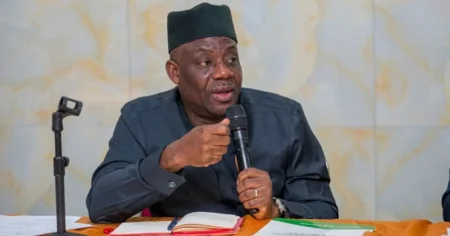
Addressing newsmen shortly after their closed door meeting, the Chairman, Senate Committee on Banking, Insurance and other Financial Institutions, Senator Adetokunbo Abiru (APC: Lagos East), said the state of the economy, especially the inflation index, was of great concern to the lawmakers.
He said, “We have held a meeting this afternoon essentially to focus on the direction of the Nigerian economy.
“We are all living witnesses of what is going on. Underlining the major issue of the economy is the way the inflation index has been and of course, it is a major concern to us.
“We have deliberated among ourselves. Critical issues were addressed and we believe that the next line of action is to summon the governor of the central bank on Tuesday at 3 O’clock to brief us properly on the state of the economy.
“That we have resolved and will communicate to the governor of the central bank after which we will have further communication with members of the press.”
Read the full article here