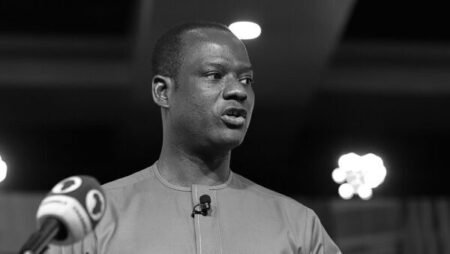






Engineer Saidu Hassan, National Chairman of the Nigeria Institution of Highway and Transportation Engineers (NIHTE) and Managing Director / CEO of Bahago Services Limited, in this interview with OLORUNDARE ENIMOLA, raises hope that the present Government will fully harness and implement the provisions of the Road Sector Reform Act, stressing that the Act can solve most of the problems in the sector today. Excerpts:
Kindly introduce yourself, what you do aside from being NIHTE President and how long have you been into the Highway construction business?
I am Engr. Saidu Hassan FNSE, FNIHTE, National Chairman of the Nigeria Institution of Highway and Transportation Engineers (NIHTE), a Division of the Nigeria Society of Engineers (NSE).
I am also the Managing Director / CEO of Bahago Services Limited. Our Company provides Consultancy Services to both Government and Multilateral Organizations in Highway and Civil Engineering.
How would you describe the state of Nigerian highways?
I can say there is much to be expected in our highways. Nigeria is a large country with the longest network of Roads compared to other countries in Africa. Road statistics are not up to date, but we have about 36,000 kilometres of Federal Roads, 30,000 kilometres of State Roads, and 85,000 kilometres of Local Government Roads.
It might interest you to note that the Federal Roads carry over 80% of the traffic. In fact, we had the best network of Roads in the Sub-Sahara in Africa in the late 1970s and early 1980s. These Roads were allowed to deteriorate without intervention.
Why are our highways in the current state they are, what factors are responsible for their present state?
As stated above, lack of proper intervention and timely response for the state has bought us where we are today.
Like we all know, we in Nigeria do not give the necessary attention to maintenance. In fact, our maintenance culture in Nigeria is very poor.
The necessary routine and periodic maintenance are not carried on our Roads as when due.
Funding has been a major challenge in this regard. Most of our Roads rely on budgetary allocations for their Maintenance, Rehabilitation and Reconstruction.
Overloading in respect of Axle loads is also a major factor contributing to the bad state of our Roads.
In the developed countries, heavy goods are carried either by Rail or by Water. But, in Nigeria, where a Road is designed for 30 metric tons capacity, most of our articulated vehicles exceed the limit, in some cases even up to 60 metric tons and above.
What are the socioeconomic implications of the state of these highways?
I want you to know that there is a saying that says, the economy does not build Roads, but the Roads build the economy. For example, in any human settlement, once a good Road is provided, you will find a lot of economic activities springing up. In fact, values of rent, properties, and rent go up.
I made the above example to emphasize the importance of Roads to any economy.
Even today, the traders will tell you that high cost of goods and services is as a result of high transportation costs.
Therefore, the implication of the state of roads to our economy cannot be overemphasized.
How can they be better handled to meet the yearnings of Nigerians, making our roads a source of national pride?
Governments have been trying over the years to improve the state of our Roads through Vision 2000, a comprehensive document by the Federal Ministry of Works to carry out necessary Reforms in the Road Sector.
The Federal Road Maintenance Agency was also created for this purpose.
We have more interventions such as SUKUK, Credit Tax Schemes, among others. All these were structured to improve our Roads.
Today we hear Governments at all levels in the country complaining about lack of funds, affecting the rapid development of our road networks, how can we overcome this, what suggestions would you proffer to pool funds and sustainably too, aside budgetary allocations, towards road construction?
There is indeed paucity of funds available to the Federal Ministry of Works and FERMA from The Federal Annual Budget to execute Critical Road Projects capable of addressing the poor state of Nigerian highways.
It has always been the opinion of the Highway Experts that the solution to the poor state of the network of Roads in Nigeria lies with the Reform of the Road Sector.
The Road Sector Reform started with the establishment of the WEY Commission in 1971, which recommended reform in the Sector, this was followed by the Road Maintenance Initiative in 1991, which culminated in the Road Vision 2000 with recommendation in the Road Sector.
In order to fulfill urgent needs, the Federal Road Maintenance Agency, FERMA, was established in 2002. The Act established FERMA did not consider the whole cycle of planning, design, construction and maintenance. FERMA could not therefore adequately address the issue in the Road Sector.
In 2012, the Road Sector Reform Committee was constituted by the Ministry of Works and Committee, produced Road Sector Reform Bills and has been passed by the 8th and the 9th National Assembly.
Unfortunately, the Bills were not assessed by the Previous Administration. The Bills are the Federal Road Authority and National Road Fund Bills. These bills will provide a sound governance structure based on sectorial professionalism.
As well as creating sustainable and robust funding for road development and maintenance in the country.
How then do we ensure strict monitoring of fund usage and ensuring that roads are constructed to specifications?
The Reforms if implemented will take care of most of the problems including the utilization of funds.
In fact, Private Sectors will be involved in the development of Roads Infrastructure, through Public Private Partnership (PPP).
It’s the responsibility of all Engineers to ensure that Specifications are adhered to religiously. We in NIHTE have always ensured that our members act professionally.
What would you say about the importance and the neglect of Trunk C roads supposed to be the responsibility of Local Governments, how can they be held responsible?
The neglect of Trunk C roads is very worrisome to say the least. Trunk C roads are very important.
These are the roads that are supposed to move our Agricultural Produce from the farms to the cities.
The high cost of foods and loss of perishable goods can be attributed to the neglect of our Local Government Roads.
The Financial Autonomy of local government is very important.
This Autonomy will enable them to have funds to develop Trunk C Roads, if these roads with the most coverage receive the required funding from the Federation, then Nigerians can hold them Responsible.
It is evident that Governments, especially the Federal Government prefer Foreign construction companies to their indigenous counterparts. What’s your take on this and why do you think the government should rethink this position?
Road infrastructure is highly capital intensive. One requires a lot of resources to adequately participate in Road construction. Indigenous companies don’t have these resources.
Therefore, the foreign companies with support of their home Government dominate the industry.
Our Banks are not helping matters. The foreign firms can get Plant / Equipment at a single digit interest rate (In some cases, with moratorium). While our indigenous firms are charged double digit, that is if they are able to secure the credit facility in the first place.
Let me give you an example. If you are bidding, they will say you need N5 billion – N10 billion Turnover. How many indigenous companies will have that? But the foreign firms can come with over N15 billion. So, right from the starting block, you are edged out.
What’s your perspective on the position of the current Minister of Works that we should use more concrete in the construction of our highways than asphalt, what are the implications in terms of cost, durability and affordability?
While the Institution of Highways and Transportation Engineers is not against the use of concrete roads, such a policy should have been subjected to the scrutiny of highway stakeholders to ensure that the appropriate engineering procedures and processes are strictly followed, and proper implementation strategies adopted.
In other words, the adoption of any of the Highway pavement types is a function of Engineering science and economics.
What’s NIHTE all about, can you recall some of its impact on road development in the country and as the current National President what have you or intend to achieve in your tenure?
The Nigerian Institution of Highway and Transportation Engineers (NIHTE), a Division of the Nigerian Society of Engineers (NSE) is the umbrella body of all Highway and Transportation Engineers in Nigeria.
The cardinal objectives of the institution are to ensure professional development through capacity building and provision of effective advocacy for Highway development in Nigeria amongst others.
We carry out Local and International Workshops; Technical visits to Roads Projects and making our inputs, observation and sharing of knowledge; Participate in National Assembly in Technical Group sessions as it’s related to Roads and Transportation, including that of the National Council of Works and Research Institutes.
We also engage in Career talks in Secondary and Tertiary Institutions and encourage Competition in schools.
I want to see NIHTE remain one of the best divisions of the Nigerian Society of Engineers (NSE), while maintaining the standards laid by my predecessors.
Read the full article here