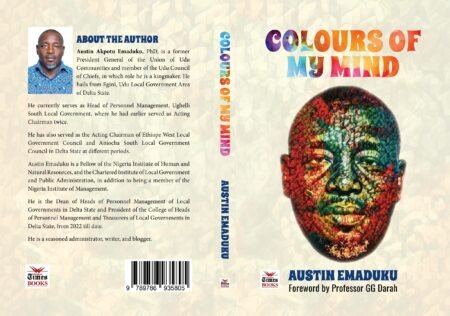









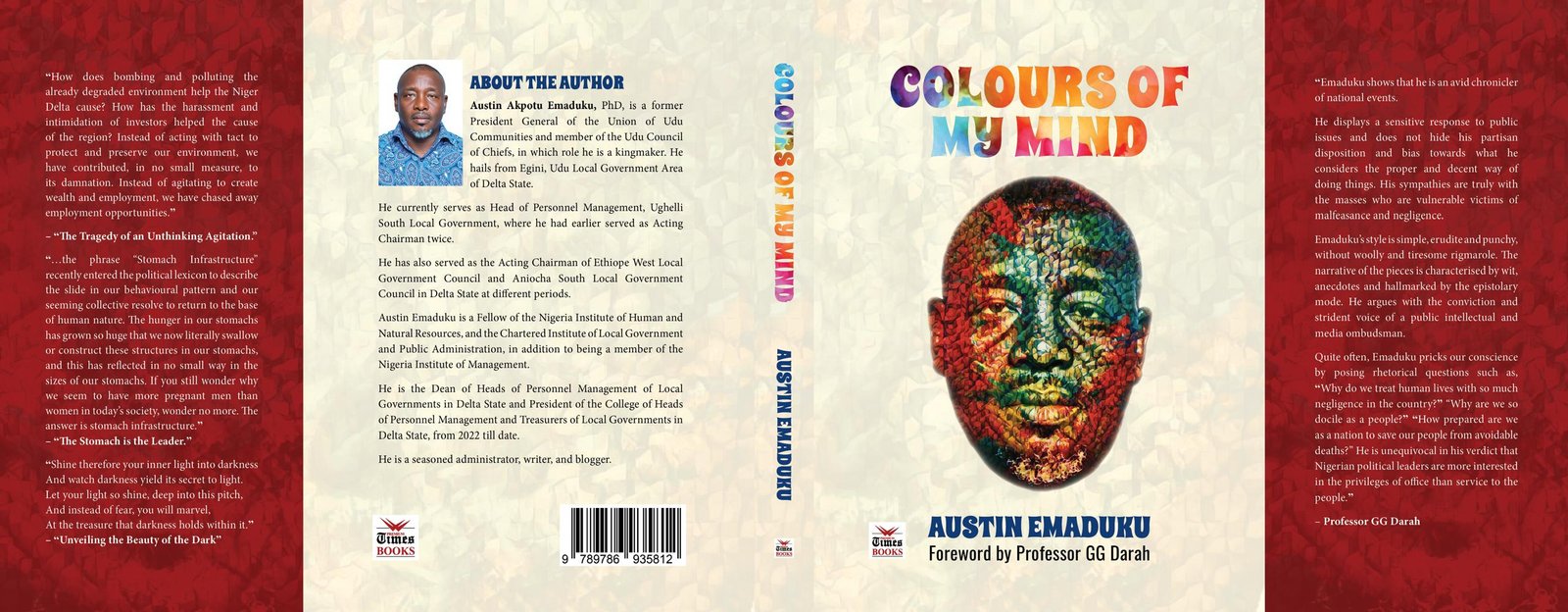

Emaduku’s “Colours of My Mind” is a product of experience and expression, which bestride different facets of the Nigerian society. The different sections of the book weave together relatable sociopolitical and cultural episodes in Nigeria. The author’s social and socialist vision reflects patriotic and transformative commitment in the Niger Delta and Nigeria. With the urgency to communicate realities, Emaduku deploys simple and rhythmic language, which occasionally infuses literary flavour. The mosaic of literary tools adds a striking sophistication to the book.
The ideas that drive and rejuvenate human communities are products of the mind, conveyed through language. In the biblical account of creation, God’s declaration, “Let’s there be light,” evidently carries a thought-process that privileges creativity and innovation. It is apt to draw a connection between this background and the assortment of ideas in Austin Emaduku’s anthology, Colours of My Mind. Spanning 2016 and 2022, the essays and commentary featured in the book reflect contemporary realities in Nigeria, underscoring the author’s vision of an improved social order.
Published by Premium Times Books, Abuja, in 2025, Emaduku’s Colours of My Mind is a 275-page volume of essays and poems on homeland and national realities. The book is logically structured into six parts captioned as chapters, which bear distinct but related thoughts about human and societal development. The systematic structuring of the book into different sections makes it easy to locate the issues that trouble our humanity and the regenerative thoughts of the author, as he desperately craves a healthy society that eschews any manifestations of abnormalities. It is, therefore, easy to trace the colours of the author’s mind as the reader follows his thoughts from page to page, chapter to chapter!
The first section of the book, “Thoughts on the Niger Delta,” features 15 essays that diagnose the socio-cultural and politico-economic condition of communities in the oil-rich Niger Delta region of Nigeria, highlighting the neocolonial repression, connivance tactics, indigenes’ naivety and some redemptive measures. From the themes of the essays that constitute this section, it is evident that the author is enthusiastic about human and community development. The opening essay in the book, “Preserving Udu History and Culture,” anchors on cultural history, and accentuates the writer’s quest for cultural reclamation. Here, Emaduku draws on mythical and legendary characters to reflect on the heroic prowess of the Udu people, which now seems denigrated as a result of the current trend of sycophantic and manipulative politicking. The thesis of this essay anchors on the urgent need to resuscitate the eroding gallantry and unifying spirit of the Udu people. In another essay, Emaduku plays with “Udu-Ovo,” the symbolic rhetoric of unity and oneness in Udu Kingdom, to demonstrate his patriotism to his cultural space.


Most of the essays in the first section of the book reflect the author’s unbiased stance on the vexatious issues in Niger Delta, especially the hooliganism that drove away investors from different parts of the region. In “The Tragedy of an Unthinking Agitation,” Emaduku laments how the insecurity created by thoughtless agitations crippled the economic state of Niger Delta communities. Decrying how insecurity “chased away the companies that would have employed our teeming unemployed youths” (p. 6), Emaduku reminisces over the lost glory of Warri metropolis, which was an economic hub in Delta State: “I can recall the mid 1980s to the early 1990s when Warri, the economic hub of Delta State, was home to hundreds of oil companies” (p. 6). This essay sends a cautionary note to Niger Delta youths who manifest aggression, educating them about the ruinous consequence of such acts of violence. Here is a takeaway for our youths: “Until we create a conducive atmosphere for investment to thrive, we will continue to be jobless” (p. 7). This idea is further broadly echoed in the next article, “Youth Restiveness, Militancy and the Intractable Problems of the Niger Delta.”
Some essays in the first section of the book dissect the disunity among ethnic nationalities in Delta State as a major hindrance to development. Here, Emaduku decries disunity and advocates for inter-(intra-) peaceful coexistence within and among language groups. The essay, “The Itsekiri and their Neighbours” conveys the author’s distaste for the thoughtless and avoidable ethnic crises in Delta State, which continue to hinder development in Warri and its metropolis. The essay indicts the Itsekiri for most of the crises in Warri, noting that, “To maintain the false sense of domination, the Itsekiris have fought and continue to fight against anything that benefits the other ethnic groups or areas which they occupy” (p. 33). This indictment arises from the author’s thorough attempt to diagnose a condition before administering therapeutics. Drawing on biblical allusion, Emaduku emphasises how neighbourliness and the love for one another is a universal law for humanity.
A significant part of this essay is the celebration of the Wado City Advocacy Movement, which, according to Emaduku, offers a “a creative, almost magic-like solution to the issue of identity that has been the underlying cause of tensions and crises which rocked the city and led to avoidable deaths in the past” (p. 33). The next essay, “Vice President Yemi Osibanjo’s Visit and the Place of the Urhobo Nation in Delta State and the Niger Delta Question,” typifies the anger of the Urhobo people, who despite being the most peaceful and major language group in Delta State, is undermined by its neighbours. The essay bitterly recalls the denigration of Urhobo kings during the visit of President Yemi Osibanjo in the years 2017, and recommends the need for the Urhobo nation to carry itself with dignity and valour. Emaduku’s consistent call for peace in the Aladja-Ogbe-Ijoh crisis reflects his quest for unity. In his words, “Well, I was on the side of peace then as I remain now” (p. 80). This is a reflection of the quality of his mind — a fertile, dignified and a dispassionate mind that desperately craves peace and its offsprings.
The episodes of disunity captured in the book also underline intra-ethnic division among the Urhobo people. Emaduku notes that the strength of a people lies in their unity and image modelling. He emphasises that the Urhobo nation should look inward, dignify itself and build a formidable stance and voice in the nation. In “Urhobo Youths, Social Media and Unthinking Criticism,” Emaduku blames the growing sycophancy and thoughtlessness among Urhobo youths who are quick to insult their leaders and ethnic nationality online, for political gains. He asserts that “constructive criticism is good and can serve as a wake-up call from lethargy for the leader(s) but criticism for criticism’s sake is ‘pull downism’” (44). He, therefore admonishes Urhobo youths to be thoughtful and discerning.
In “Leave the Urhobo Progress Union (UPU) Out of Your Partisan Politics,” Emaduku censures the deep-seated sycophantic politics that continue to defame the Urhobo nation, which has badly inferiorised the exalted image of its apex body, the UPU. This thesis is also depicted in the essay, “The Need to Separate Partisan Politics from the Upcoming UUC Elections,” underscoring a consistency that highlights Emaduku’s quest for unity and cultural dignity in Urhobo. Emaduku’s vision for societal improvement and revulsion against hypocrisy is what he allegorically portrays as Colours of My Mind. That is, the book is a representation of his mental quality; a liberated mind that seeks the redemption of other minds. That consistency inheres in the articles.
As the past President General of Union of Udu Communities (UUC), Emaduku’s interventions on electric power supply are captured in some of the essays. He understands the import of stable electricity for the industrialisation of any human community. This is why he resents the injustices manifested by BEDC in Udu, captured in reprimanding lament with the essay, “Help! BEDC is Returning Udu 30 Years Back to the Days of Rural Electrification Boards (REBs).” As a patriotic leader driven by the vision to develop his communities, Emaduku recommends steps to be taken by the incoming President of UUC, for the advancement of Udu.
The second section of the book, “Restructure or Rupture,” engages the Nigerian federation, dissecting intractable challenges and rescuing measures. The essays featured in this section advocate for total restructuring of the Nigerian federation as a panacea for peace and development in Nigeria. Emaduku submits that “what the nation needs is the return to a true federal structure with minimum central might” (p. 93). He advises Nigerian leaders to “make the centre less attractive and the tensions will cease” (90). Illustrating further, he notes that “Each federating unit will become more acutely aware of its strengths and weaknesses and will consequently respect the strengths of other regions over its own weaknesses” (pp.90-91).
These submissions emphasise his deep knowledge of the Nigerian political experience. In “The Conflagration Will Come from the North,” Emaduku advises that, as a nation, we must eschew every ethnic and religious sentiment and solve the raging issue of poverty in the Northern part of Nigeria. Evidently, the issues of terrorism and banditry were triggered by poverty and lack of education, which are now affecting every part of the country.
The third and fourth sections of the book, “When Democracy Insults” and “Nigeria, We Hail Thee,” feature essays that dissect the Nigerian political situation. Emaduku’s disgust towards the manifest sycophancy and docility in the Nigerian society is captured in the essay, “Our ‘Mumu’ Our Fears?” which challenges Nigerian citizens to eschew fears and hypocrisy, and hold their leaders to account. The pidginised word, ‘mumu,’ which translates to ‘idiocy,’ reflects the author’s disdain for foolhardiness and hypocritical loyalty in the Nigerian political landscape. Other representative essays that resent the growing stupidity and absurd conducts of the Nigerian masses are “Gullibility and the Average Nigerian,” “The Self-Devaluation of the Nigerian Electorate,” and “The Stomach is the Leader.”
Emaduku’s political orientations and activistic ideological inclinations are expressed in a good number of essays featured in section three and four, including “Human Right and Minority Opinion,” “The Arrest and Release of Journalist, Chido Onumah,” #EndSARS,” “The Injustice in the Nigerian Prison System” amongst others. His essays on electoral malpractice in Nigeria and his insights on free and fair elections are compelling.
The fifth section of the book reflects on religious and cultural experiences. Aptly captioned as “Of Culture and Religion,” Emaduku decries the destructive manifestations of religious sentiments in Nigeria. In “The Familiar Spirits of the Nigerian Nation,” he identifies religion as one of the main causes of the Nigerian predicaments. He declares that “of all the familiar spirits, religion is the one that has been mostly deployed, sometimes with devastating effect, due to its emotive nature” (p.229). Emaduku does not merely narrate the damages caused by ethno-religious sentiments in Nigeria, he stimulates a conversation and orientates the public to shun the destructive fanaticism caused by religion in Nigeria, which include political docility, sycophancy, violence and terrorism. Some of the essays in this section ridicule religious hypocrisy, while others interrogate our dwindling mores and values.
The sixth and last section of the book, uncovers the author’s creative inclination. This section, titled “Colours of My Mind,” highlights Emaduku’s literary forage into poetry and narratives. The poems and autobiographical narratives in this part of the book embody related sociopolitical and cultural realities in Nigeria and elsewhere. They attest to Emaduku’s social vision and transformative fervour.
Emaduku’s Colours of My Mind is a product of experience and expression, which bestride different facets of the Nigerian society. The different sections of the book weave together relatable sociopolitical and cultural episodes in Nigeria. The author’s social and socialist vision reflects patriotic and transformative commitment in the Niger Delta and Nigeria. With the urgency to communicate realities, Emaduku deploys simple and rhythmic language, which occasionally infuses literary flavour. The mosaic of literary tools adds a striking sophistication to the book. This is a great and resourceful compendium that every Nigerian, especially indigenes of the Niger Delta, should have. It memorialises different experiences in the Nigerian sociocultural and political landscape. I, therefore, enthusiastically recommend this book without any reservations whatsoever.
Stephen Kekeghe (PhD) is a Senior Lecturer at the Department of English and Literary Studies, Delta State University, Abraka.
Discover more from Premium Times Nigeria
Subscribe to get the latest posts sent to your email.
Read the full article here