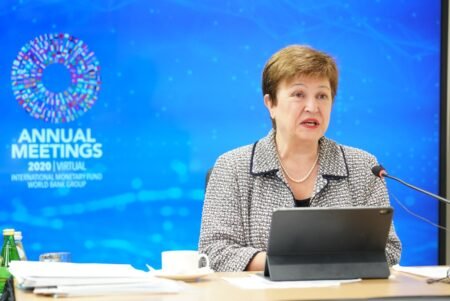





“Nigeria to become Africa’s fourth largest economy in 2024 –IMF.
Every administration gets branded for posterity by one or two landmark occurrences or achievements during its tenure.
Chief Obafemi Awolowo, as Premier of the Western Region, will be remembered for the introduction of free primary education, the first television station and the first lighted stadium in Africa.
General Gowon gave us the first tolled expressway, the Lagos-Ibadan roadway, and his government already planned the second, third and fourth — Sagamu-Benin– Benin-Asaba, the Kano-Zaria-Kaduna roads.
Murtala Mohammed/Obasanjo/Yar’Adua established Federal Government Colleges and universities in all the states of Nigeria, as well as the Federal Capital Territory.
Later, after the brief return to civilian rule, Buhari, as Military Head of State, led the country into its first economic recession and acute scarcity of essential commodities from 1984 to 1985.
President Babangida followed with the most badly misunderstood Structural Adjustment Programme, SAP which failed to achieve most of its objectives on account of widespread economic sabotage led largely by bankers and industrialists.
Fast forward, we leave the military period behind us; and move to the return to civil rule in 1999; when Obasanjo was again the President with promises to eradicate corruption – which was widely recognised as the cardinal obstacle to Nigeria’s rapid development.
Shortly after he was declared the winner of the 1999 election, in an interview with CNN’s Christiana Anampour, Obasanjo was asked what his major priorities were.
Without hesitation, he declared that he would fight corruption to a standstill and eradicate poverty.
He failed to achieve any of his stated objectives. If anything, he made the situation worse on both counts.
But, he achieved two major goals. He got Nigeria out of the debt trap into which he was the first to lead the nation with the $2.8 billion loan he took in 1978; and he gloriously led Nigeria into the age of internet and cyber technology by licencing the telecommunications networks.
It was a monumental game-changer for Nigeria. Despite that annual Gross Domestic Productivity, GDP was below three percent average per annum.
Nigeria’s second chance to make a dent on poverty occurred during Jonathan’s tenure from 2012 to 2014, when GDP growth averaged more than five per cent.
That was the first time since the 1970s and Gowon administration when the nation experienced over seven per cent growth in one year.
In 2014, Jonathan’s last full year the GDP growth was 4.2 per cent. But, Nigeria achieved a remarkable milestone.
In that year, our nation was proclaimed the largest economy in Africa. The title was held for nine years during which it was steadily undermined by Buharinomics.
Buhari inherited a weakening economy as the global price of crude oil which made it possible for Jonathan to excel started declining.
A recession was inevitable when Buhari came into office. The first occurred in 2016 during Buhari’s first term; and the second in 2020 during his second term. Sandwiched between the two recessions was another title conferred on Nigeria.
In 2018, this nation became the world poverty capital – beating India, the longest reigning champion to a title no nation covets.
From 2018 till now, while Nigerians were distracted from the global race for economic dominance, other African nations were steadily growing their economies and strengthening their currencies.
When President Bola Tinubu announced that “fuel subsidy is gone” during his Inauguration Address on May 29, 2023, little did he realise that in one step he had set rolling a chain of economic reactions which would send Nigeria down from first to the fourth economy in Africa; and render achieving top 20 rank virtually impossible during his tenure even if it lasts eight years.
Thus, very early in his tenure of office, the country has been demoted in rank. That fall from the top will have consequences – some of which will be revealed later.
But, one can be stated here. Nigeria has become the only country, with the largest population, on any continent which is not the largest economy at the same time.
How Did We Get Here?
“Telling the truth and accepting the truth has been our major problem in Nigeria.
Some people will never tell you the truth when you are in power; and honestly, many of us in power also do not want to hear the truth.”
Professor Babangana Zulum, Governor of Borno State, 2021.
The situation in Borno State and our abhorrence for economic truths serves as metaphor for what has sent us into the fourth position on our own continent.
Zulum has received a great deal of commendation for the quantity of food stuffs his government has distributed as palliatives – especially since last year.
But, it is doubtful if anybody close to the Governor had told him that with the largest number of Nigerians Internally Displaced Persons and idle while breeding like bed bugs, in Borno state, palliatives are counter-productive.
What most of the people need, to be productive, is to return to their farms and work.
That remains elusive because of Boko Haram and other hoodlums.
The same is true of other Northern states of Nigeria which are characterised by idle hands and untended farms.
Perpetual food scarcity is guaranteed as long as insecurity reigns supreme.
Jonathan and Buhari failed to deal with the problem adequately; each preferred propaganda to performance.
There has been no significant improvement under Tinubu.
Boko Haram still rules Sambisa Forest. Just recently the army had to relocate from its base in Niger State after it was attacked by hoodlums.
From information available to me, farmers have also deserted the community. If soldiers run, farmers run faster. The outlook for food supply remains bleak until we sort out the security issue.
“Nigeria would have gone bankrupt if subsidy was not removed.” President Bola Tinubu announced recently.
That is the absolute truth. But, that truth was known to Buhari, Jonathan, Yar’Adua and Obasanjo. The only Head of Government who confronted fuel subsidy, head on, was General Abacha.
The rest caved in to popular pressure – led by Adams Oshiomole – and either deliberately or inadvertently sabotaged the Nigerian economy cumulatively.
The situation Tinubu inherited was what would have confronted anybody elected in 2023 – an economy totally destroyed by its political and business leaders.
All economies run on power and fuel supply. Leaders elsewhere ensure that power supply grows with population and industrial progress.
Yet, actual daily guaranteed power supply has remained stuck at 3,600MW achieved ten years ago under Jonathan.
Obasanjo promised 10,000MW, Jonathan 14,000MW and failed to deliver.
Buhari promised nothing and delivered no improvement in eight years. Below was the ranking as at 2021 of African countries:
South Africa 63.28MW; Egypt 60.07MW; Algeria 21.69MW; Nigeria 11.70MW.
While the rest distribute virtually all the power generated, Nigeria evacuates less than 40 per cent.
By the end of 2024, South Africa, Egypt and Algeria will have bigger economies than Nigeria. The gaps might grow wider over time.
………Follow us on Facebook @J Israel Biola
Read the full article here