






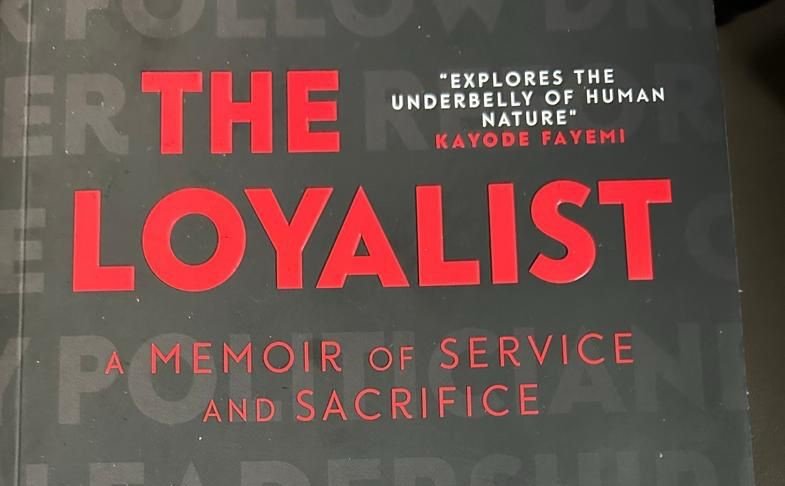
The Loyalist: A Memoir of Service and Sacrifice by Bolaji Abdullahi is a riveting, thought-provoking work. A narrative cobbled together in a span of 287 pages, it is a book that not only provides the missing links to tissues of recent Nigerian political history, it breaks boundaries of assumptions, and explores the delicate frontiers of loyalty to political principals. It breaks boundaries without wielding a digger, says a lot in taciturn prose and performs cremation on widely held assumptions and personalities without an outward appearance of flame or ashes.
It is a 13-chapter book written in a nonlinear narrative technique. Rather than the usual traditional chronological order of narrations which curves from the beginning, middle to the end, Abdullahi here pens a meandering narrative which oscillates between past, present, and sometimes future events, to arrive at a compendium that is a beauty to read. While it is an account of the author’s metamorphosis from a public intellectual into a journey of public service, it painstakingly explores the thorns, uncertainties and fault lines of political loyalty. The book dissects the theme of political loyalty, its ephemerality and the gradual transformation of political principals into demi-gods. Carefully, with the finesse and painstaking patience and candour of a sculptor, it gradually chisels a chronology of political events from its very beginning, to the raison d’etre of the fall of a political empire.
In a masterful writing style which will have the reader delightfully following the author as he weaves strands of his public service odyssey together, Abdullahi strewns words like a tapestry, narrates events like a story teller and creates lasting images with little effort. The Loyalist is so well written that it is unputdownable. Its narration is so believable because reading it is a pleasant travel.
By deliberately removing his personal verdict from the loop of the collapse of the political marriage between him and his principal, and pushing its verdicts outside of his own window to the live conversations in the book, his narration becomes verifiable, receives authenticity and is difficult to fault. Even when the narrative is his and the story is woven around events that have him playing central roles, the author infuses consequential words into dialogues, into the very mouths of the dramatis personae of the narratives, thus standing aloof as if a bystander or an ordinary chronicler of his own history.
The thirteen-chapter The Loyalist is broken into titles like Forty thousand feet above; Homecoming; A twinkling star; Sowing the mustard seed; A warrior of light; Love is not enough; God’s Minister; The winner stands alone; A blind date; Spoils of war; The dreams we carry; Hope dies last and Remains of the day. It ends with a postscript. Journeying with the author along these sections is not labyrinthine but a pleasurable journey where each lift of legs is a thirst to lift another further.
The book is prefaced by a 2019 event at the 46th Santa Barbara Writers Conference. Attended by the author, it became a catalyst for the thought of penning this memoir. A section on creative non-fiction writing handled by Dr Diana Raab, which bifurcates a memoir as belonging to a different compartment from an autobiography, reinforced the author’s decision to write this memoir. The various philosophical backgrounds to writing the book, how it began as a roaming idea on his head, its troublous inhabitation of his mind for five years, as well as the process of its maturation for writing, are discussed here.
The first chapter of The Loyalist, euphemistically entitled Forty Thousand Feet Above, clearly goes beyond an airplane seeking to gain altitude. That title and the engagements the reader will have in this first chapter, are a foretaste of the philosphizing of occurrences that litter this book. The authorial licence demonstrated by the author here is unique. A take-off narrative, leading to the zenith of the totality of the narratives in the book, this chapter can pass for an enjambment, a sentence without a pause beyond the end of a line in the verses of a poem. Why did the author decide to begin the book from an unpleasant experience in his public service? Why did he begin his narratives with the events leading to his sack as minister by the Goodluck Jonathan government? This is one question that will immediately detain the reader. It must be a literary plot by the book to detain its audience without a warrant. Having been successfully detained by this question, the reader never recovers until he seeks its denouement, which he never gets until its end. The book then manages to cleverly provide a correlation between the take-off of the author’s flight to London and his not unexpected sack.
The reader is faced with soul-aching, overwhelming gang-ups against the author’s continued stay in the Jonathan government by the president’s acolytes and appendages. Not on account of under-performance but the baggage of his loyalty to his boss, Bukola Saraki. The reader’s empathy for the author is tested to its elastic limits. He sees it hanging prominently in this chapter like a notorious pimple on the head that cannot be hidden. What is however unambiguous from this first chapter is that, by beginning the narration from his public service vicissitudes, the author tries to enlist the empathy and sympathy of its readers, perhaps seeking their shoulders to lean on in the greater daggers to the heart that lie ahead.
In this same chapter, worthy of a read is the narration between the author and his daughter who he met upon arrival in London. Her pride in her father losing his job for the sake of loyalty, without it being said, underscores the eternal pearl that loyalty is, irrespective of its coming in the midst of a fiery tempest. This loyalty is enveloped by turmoil, with uncertainty and tribulation lying ahead of the author’s future.
Aptly entitled Homecoming, chapter two of The Loyalist provokes emotional comfort in the heart of the reader. While the first chapter paints the picture of despondency and disappointment, the second offers hope and respite. It is a celebratory chapter containing the narration of the hosting of the “son of the soil” who had demonstrated fidelity and forthrightness of loyalty to his principal. The reader reads of how Kwara State and its capital, Ilorin, stood still for the author, a payback for his unflinching loyalty to Bukola Saraki and the political family that he represented.
Chapter three reveals the ambiguity and I dare say, the unusual aesthetic and episodic arrangement of the book It is a testament to an earlier reference to the nonlinear narrative technique the author chose to tell his narrative. Here, the reader goes backwards to the very beginning of how the author came to bond with his boss and principal. Hitherto, Mallam Abdullahi was a star in the Thisday newspaper firmament. The narrative here explains how his column in the newspaper became the attraction and fascination for Buikola Saraki and how their first meeting eventually morphed into his becoming one of his aides as governor of Kwara State.
Sowing the mustard seed is a chapter which narrates the author’s odyssey in government; his scorecard, if you like. This chapter happens to be the lengthiest thus far. It explains how Saraki initially deflated his ego balloon by earlier offering him the position of a Special Assistant on Communication and Strategy. While the reader wonders how he wriggles out of this deflation, he is not long after assuaged by the author’s catapult to being a Special Adviser on Policy and Strategy to Governor Saraki. The chapter also contains Saraki’s ingratiation of self and grafting of his atypical method of leadership into Kwarans. This leadership style is alien to a people used to an ancient cash dole-out system and genuflection to leaders for pittances.
The next chapter, A warrior of light, appears lengthier than the former. It is also a documentation of the author’s fare as commissioner for education of Kwara State in Bukola Saraki’s second term tenure. It documents the crass illiteracy that decades-old system of education had foisted on the people. By doing this, it also reveals how politicisation of education forged a system of education that significantly limited pupils and students’ innate potentials. In the same vein, the chapter documents Saraki’s support, his abiding commitment to rewriting the system he inherited and the support he gave to his commissioner in his avowed task of revolutionizing the course of education in the state.
Without saying so, this chapter underscores the author’s avowal to forge pupils of Kwara schools, from a rusty, rough gold, into an ornament of global significance like himself. Having been born in the hinterland, in a village called Beri, in Kotangora, Niger State, son of a tailor and farmer father, “who taught himself to read so he could take measurements and read the Quran in Yoruba” and who “started my education under a tree and was first taught the English Language in Hausa,” in this chapter, the reader would read meanings into the author’s fastidious attempts to make copies of himself from those children. From the sordid picture painted here, the education system seemed to have sworn to drag these children further down the ladder. It is a chapter containing details of the education reforms of the Saraki government under the author as commissioner.
Love is not enough is an unraveling juncture in the public service career of the author. It marks a gradual ripening of a familial animosity for which differing political alignment is a catalyst. The author and his beloved sister of same parents are flung apart on account of their political persuasions and alignments. It is also a juncture where the author begins to, in the familiar lingo of the Gen Z world, “smell the coffee” of political decisions. While brilliance and loyalty are hands-on in the hands of political czars, other considerations beyond them are responsible for the appointments they make into political positions. Quite tellingly, the author also soon finds out that political principals are like gods who are averse to being dictated to. Aides are like anvils in their hands which are to be wielded at their convenient behest. When he suggested to the god that he would want to be made the Kwara State Secretary to the State Government after their eight-year tenure, the author must have ruptured an ancient cord in the master-servant relationship.
The cruel truth that comes out of this is that every aide, no matter the level of their loyalty, is a rafter among myriads holding a tent aloft. The ultimate decision on the placement of each rafter, and the geography of its placement, are buried in the mind of the tent. The loyalist is expendable.
If anyone thinks that fatality is a scam, God’s Minister disclaims them. This chapter in The Loyalist is a narrative of how fate plays central role in the author’s nomination as minister of the Federal Republic of Nigeria by President Jonathan. However, the chapter also speaks to the elasticity of fate. That though fate takes you to the place of your zero imagination, it does not necessarily goes with you all the way. This grim reality is captured on p114 of the book where the author writes, “A minister’s job is perhaps the most precarious that anyone could have. You could only be certain that you had a job when the day ended and there was no announcement that you had been sacked. Each day I woke up, I asked myself, ‘what if it is today?’ I imagine this must be how it feels for condemned prisoners waiting to be executed.” How could anyone have thought of this ever being the lot of “Almighty” ministers? In the chapter, the author then goes ahead to narrate the everyday mundanity of ordinary people that also preoccupies the minds of even men and women in the highest echelon of power and how trivia even sometimes obsesses them.
The precariousness earlier alluded to by the author strolls in majestically in the eighth chapter, with the title, The winner stands alone. As Bukola Saraki’s politics determines the barometer of anger against the author in the presidency, this chapter articulates how Saraki’s stand on the fuel subsidy debate became a poison that further polluted the waters of the author’s continued stay in the Jonathan presidency.
As minister of youth and sports, many Nigerians would be learning for the first time his grim encounters and what indeed transpired in the 2007 Africa Cup of Nations which took place in Johannesburg. The politicisation of Coach Stephen Keshi’s abrupt resignation after Nigeria won the AFCON cup, the reader will find out, is also a tissue of the adrenaline-spiking moment that was hidden from the public. This constitutes part of the melancholy of office that the author had to grapple with. How the author valiantly rises to take his fate firmly in his hands, thereby upturning the Swords of Damocles that hung on his head over the Keshi resignation, will be clear to the reader after jouneying with him in this memoir. Also in this chapter, like Bob Marley’s quip in his Kaya 1978 album about the colour of philosophy that is as “light as a feather” yet “heavy as lead”, the reader would come face to face with the reality that, though light on the outward, the humongous weight of the Bukola Saraki loyalty which the author shouldered as minister was overwhelming. Derided as a saboteur by the Jonathan presidency, yet he struggles against time while being perceived as a wolf in the midst of sheep.
READ ALSO: How PREMIUM TIMES Books is using publishing to strengthen Nigeria’s democracy – Musikilu Mojeed
The chapter also allows the author to make a confetti of all his achievements in the ministry of youth and sports, especially the AFCON victory. Escaping the Sword with the AFCON win, it was time to savour the victory. It is here he is faced with the naked calamity that was averted, especially his earlier expressed apprehension in the preceding chapter that “You could only be certain that you had a job when the day ended and there was no announcement that you had been sacked.” Not many people knew the ounce of adrenaline he expended in securing the reversal of Keshi’s resignation. The chapter also affords the author an opportunity to outline his frustrations and heart-stabs. The London 2012 Olympics and the failure of the Nigerian team, which a newspaper aptly dubbed “N2.3b Down The Drain!” must have been a gasoline poured in the vitriolic fire of the author’s fate as minister.
In this same chapter, the reader will enjoy the author’s apt philosophising of the AFCON cup. It was weightless as a feather, yet heavy as lead, he opined. After he was handed the cup, he took the trophy home. The second day, looking very insignificant beside him in the car, he looked at it with the eye of a scientist who had just seen a strange object drop from the sky. His comment is apposite: “I glanced at the trophy.To think that this unremarkable object had sent the entire African continent into a frenzy over the past three weeks. To think that it was because of this object that blood had been spilled, tears shed, and billions of dollars spent. Now, as I looked at it lying on the floor of my car, I burst into laughter. I laughed so hard that my driver must have wondered if the pressure had finally overwhelmed my mind. The whole thing felt like a farce.”
Yes, the whole thing is a farce. A blind date, the ninth chapter of The Loyalist, is a choreography of the farcical chair that Nigerian politics seems to be. It speaks to how seemingly unrelated political weather could determine the geography of the life of a political appointee. It is in this chapter that the author narrates how, having been named as Deputy to the ex-Governor of Ekiti State, Kayode Fayemi, as Director of Policy & Strategy of the Muhammadu Buhari campaign. It ended as a blind date, further complicating his drive to hold on to a latch in political office.
Read the full article here