






ANDREW UTULU
The School of Eloquence, Nigeria Customs Service (NCS) and Maritime Workers Union of Nigeria (MWUN), collaboratively trained members of the Association of Maritime Journalists of Nigeria (AMJON), recently, on the operations of some of the Agencies in the sector.
The essence was to update the journalists on their activities for effective and accurate reporting of the sector.
The resource persons also engaged the journalists on the right terminology on their reportage and publications in line with ethics of the profession.
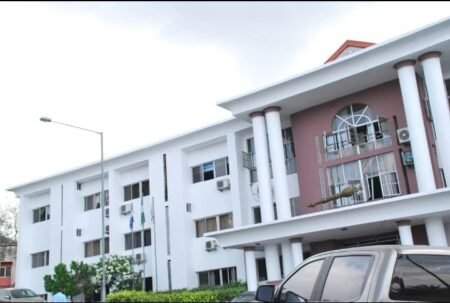
The training took place at the School of Eloquence, Osborne Road, Ikoyi, Lagos.
Resource persons were drawn from the Nigeria Customs Service (NCS), Maritime Workers’ Union of Nigeria (MWUN) and School of Eloquence.
The resource persons include Dr. Ubong Essien, Dean, School of Eloquence, Comrade Harry Tonye, Deputy President General (MWUN), Comrade Oniha Odigie; Deputy Secretary General MWUN, Head of Media MWUN, Comrade Kennedy Ikemefuna and Barrister … the Legal Adviser, MWUN.
Others are the National Public Relations Officer (NPRO), Abdullahi Aliyu Maiwada, who was represented by the Customs Public Relations Officer, Lagos Free Zone, Abdullahi Lagos Abiola, a Superintendent of Customs (SC). Abiola delivered a paper titled: Understanding the new Customs Act 2023.

Also, among the resource persons also is Victor Ejezie, a computer guru, who lectured the journalists on various aspects of on-line reporting, including how to improve online traffic and efficiency, accurate reporting, compelling headlines and multi-media interpretation, among others.
Fielding questions on Special Economic Zones and Free Trade Zone, as outcome of the paper he presented, the Customs image maker harped on the need for stakeholders to leverage the benefits of Special Economic Zones (SECs) and Free Trade Zones (FTZs), saying they are viable avenues to attract more Foreign Direct Investments (FDIs) into the country.
Abiola, who spoke on Understanding the New Nigeria Customs Service (NCS) Act 2023 and how it would enhance economic growth, said public relations remained crucial to any organization, adding that the CGC Adewale Bashir Adeniyi’s rise to the Controller-General of Customs (CGC) remained a major source of motivation for serving junior Public Relations Officers of the NCS.
Maintaining that economic growth depends largely on ease of doing business and adherence to the rule of law, among other factors, he said the NCS was generally shifting from over emphasis on maximum revenue generation and anti-smuggling to international best practices in customs operations.
“There is no need to be hostile in enforcing customs operational rules. More so, the Comptroller-General of Customs is aiming for civilized customs in Nigeria, by ensuring that officers move away from the old ways of doing things to international best practices and standards of doing things.
“The Nigeria Customs Service is also shifting from the outdated regulations and cumbersome operational models and encouraging businessmen and all stakeholders to be compliant traders. Sections 7, 14 (5) and 18, which set up a governing board, funding sources for sustainability for Customs operations, are meant to improve standards and align with international best practices,” he stated.
He, however, disclosed that the NCS Act 2023 was facing some challenges including implementation huddles, expensive technology infrastructure, continuous comprehensive trainings for officers, vigilance against corruption and stakeholder engagement, among others, adding that in spite of the NCS’ emphasis on adequate revenue generation, it aims at simplifying trade operations that align with global trends and best practices.
Abiola also urged stakeholders to leverage the Special Economic Zones and Free Trade Zones, as well as cooperation and collaboration for trade facilitation to attract higher FDIs and grow the national economy for the greater good of all citizens.
Also speaking, Dean, School of Eloquence, Dr. Ubong Essien, urged them (journalists), to enhance their reportage of the Nigerian Marine and Blue Economy and take advantage of the economic benefits inherent in the sector.
Essien, who was a former Special Adviser on Media and Strategy to the immediate past Director General, Nigerian Maritime Administration and Safety Agency (NIMASA), Dr. Bashir Jamoh, called on the media practitioners to create wealth for themselves through effective and quality reportage about the Marine and Blue Economy , saying that the sector was under-reported by journalists.
He said it was important for media practitioners to create wealth and prosper through effective and quality reporting of the Marine and Blue Economy, stressing that the maritime industry was not only about the sea and shipping and that the blue economy is vast to the extent that journalists could choose their areas of specialization to create wealth for themselves.
Essien maintained that journalists were as crucial to national development as their lawyers and oil workers counterparts and as such, they should be able to earn a decent living with regard to the basic provisions of life and being able to pay their bills comfortably, insisting that journalism and law professions remain sacrosanct in driving consciousness in the evolution of modern societies.
Describing “Knowledge as power”, Essien stated that training and retraining of members of AMJON is a clear indication of wealth creation urging them not to relent in pursuit of academic abilities and upscaling of their knowledge base.
Speaking further on the multiple advantages of the sector, the media mogul reiterated that the maritime industry is not limited to the ocean or ships, maintaining that the blue economy is vast to the extent that a journalist can choose to specialise on a segment and get the desired relevancy to create wealth.
According to him, journalists can specialise on any given sub-sector within the industry, improve on it and create wealth from it.
While commending AMJON for the innovation, the Dean stressed that the school is open for partnership in the area of capacity building for members adding that journalists must equip themselves with modern day technologies like use of social media, Artificial Intelligence, Google, among others to create the needed awareness for the Marine and Blue Economy growth.
He further described journalism and the legal practitioners as noble professions, which in turn has the capacity to enlighten the public about new innovations, thus the professionals must be strategic while engaging critical stakeholders for nation building and economic development.
He also appealed to members of the association to prioritize capacity building as a veritable tool to gain more knowledge.
Earlier in a welcome address, President of AMJON, Paul Ogbuokiri, commended the management of the School of Eloquence for providing the facilities for the training programme.
He charged maritime journalists to take advantage of the training to update and upgrade their reportorial skills.
Ogbuokiri, who restated the association’s commitment to always ensure comprehensive reporting of the maritime industry, said members of the association have resolved to collectively pursue the School of Eloquence’s Master class programme.
While fielding questions from the journalists following the paper presented, the MWUN, assured that the Federal Government was working towards payment of pensions to the retired/disengaged workers of the defunct Nigerian National Shipping Line (NNSL).
President General of MWUN, Prince Adewale Adeyanju disclosed this during question-and-answer session.
The disclosure was coming on the heels of the conclusion of verification of the disengaged seafarers of the NNSL, after 28-years of liquidation of the national carrier over their unpaid benefits.
Adeyanju, who was represented by the Deputy President General of MWUN, Comrade Tonye; vowed that the union would leave no stone unturned to ensure that the disengaged seafarers get their due pension.
He, however, did not give the exact date aged seafarers will receive their pensions.
Comrade Adeyanju, who took the journalists on the rudiments of the operations of the union, its duties to workers, noted that the Nigerian port industry had continued in a state of stability and peace because of the Collective Bargaining Agreement strategy put in place to ensure that workers are paid living wages. He disclosed that the agreement is reviewed every two years.
“The good thing about it is that if there is anything that was not captured in the agreement, one can patiently wait for the next two years for it to be addressed,” he said.
Read the full article here