






Anastasia Ani crouches as she scoops water into a bucket at a shallow edge of the river. Mrs Ani removes debris on the surface of the light green-coloured water with her plastic bowl as she fills her bucket.
For residents of Umuenwene Iji Nike, a community in Enugu East Local Government Area of Enugu State, Mmiri Ihe Ọjọọ river is both a blessing and a curse. Its name translates to the river of bad things in Igbo, the language widely spoken in south-east Nigeria. Yet, every day, residents trek to the river with buckets and kegs.
“This water is dirty,” Ifeanyi, another resident, says. “But we don’t have an alternative. The borehole is very far from here and the water is for sale.”
Residents who can afford it buy water from the private borehole, but this arrangement is not sustainable in a country where more than half of the population is poor.
Chidinma Ukachukwu says it costs about ₦600 to fill her family’s storage tank with water from the borehole. “It was only filled yesterday,” she says pointing at the plastic container. “It usually lasts a day or sometimes two days,” the mother of five says.
Public water systems provide 90 per cent of the water supply in middle and low-income countries. But in Umuenwene Iji Nike and many other communities in Enugu State, over 2.5 million people lack access to potable water. Public water supply is made difficult by the state’s undulating landscape. Residents said the only public borehole in Umuenwene Iji Nike broke down over 15 years ago, after the administration of former governor Chimaroke Nnamani.
“Since then, several administrations have promised but nobody has resolved the problem,” says Chukwudi Okonkwo, who has lived in the area for over two decades. Mr Okonkwo says reprieve only comes for residents when they have “water from the rooftops during the rainy season.”

Contaminated Water Source –
Arecent study found the presence of heavy metals and other materials like phosphorus, lead and selenium in Mmiri Ihe Ọjọọ. The pollutants were traced to fertiliser runoffs from surrounding farms and other human activities.
The World Health Organisation notes that communities with contaminated water like Umuenwene Iji Nike risk contracting water-borne diseases like cholera, diarrhoea, dysentery, hepatitis A, typhoid and polio.


“My children always have rashes that itch them,” Mrs Ani says. “Apart from rashes, we suspect that maybe internally the water is harming them too.”

The ions in heavy metals are highly resistant to microbial degradation. They can last for extended periods in water and do not break down in boiling water. These heavy metals can build up to hazardous amounts within the bodies of plants and other living things which may impact people through the food chain.
According to the National Institutes of Health, prolonged exposure and consumption of contaminated water and its habitats can damage organs, lower energy levels, and harm the brain and other vital organs. Boiling the water does not remove harmful metals like chlorine and lead.
Symptoms from exposure to heavy metals and water pollutants may include gastrointestinal, renal, and neurological symptoms which can range from headaches, abdominal pain, irritability and scratchy feelings, as experienced by Mrs Ani’s children, to more severe issues like abnormal heartbeats, anaemia, and even cancer.
Risks of contaminated water
Cosmas Achikanu, a professor at the Department of Applied Biochemistry, Enugu State University of Science and Technology (ESUT), spoke about the risks of heavy metals contamination on the environment.
“These heavy metals can accumulate in plants, vegetables, and aquatic organisms (fish) found in contaminated rivers can also accumulate heavy metals – they don’t excrete metals. These metals accumulate in their organs. They attack the organs basically by producing reactive oxygen species which alter the DNA structure.”
Mr Achikanu further states that “people who are exposed to an environment that releases heavy metals, like those who work in the paint industry, people who drink contaminated water or eat fishes from contaminated water, stand a high risk of this poisoning. Heavy metals are carcinogens and can cause cancer of the skin and kidney.”
Healthcare facility neglected
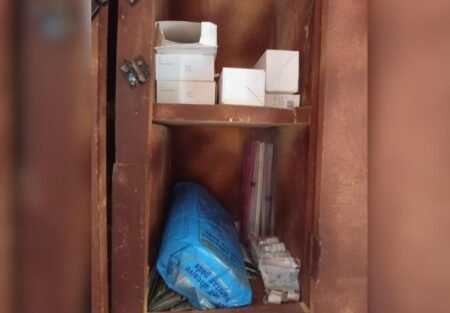
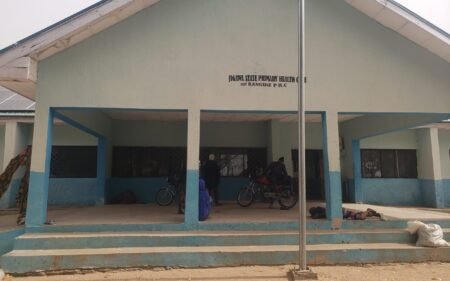
To investigate public health issues in the community, PREMIUM TIMES visited its only public primary healthcare centre and found it in a deplorable state. The facility has only two permanent staff.

Stella Odo, the consulting Community Health Extension Worker (CHEW) in charge of the PHC, says it was a beneficiary of the Basic Healthcare Provision Fund (BHCPF), although the physical condition of the facility did not indicate this.

Mrs Odo says the PHC serves over 66 communities but does not have adequate manpower, security, infrastructure and water.
“We buy water from the monthly fund and use rainwater to support ourselves,” she says. Asked if she is aware some of her patients drink water from the river, she nods. “They are drinking it nah, what will they drink? They are using it for everything. If you don’t have money for pure water, you’ll go down there.”

Limited access to improved water and sanitation facilities in Nigeria plays a major role in the high rates of illness and death among children under five years old. Due to their vulnerability to water-related illnesses, as many as 70,000 children in this age group die annually in the country, UNICEF says
These alarming figures clearly indicate that Nigeria is far from achieving UN SDG -6, which aims to ensure access to clean water and sanitation for all by providing safe drinking water, and sanitation facilities, and promoting hygiene practices. It emphasises improving water quality, efficiency, and sustainable resource management to address the critical need for human health and well-being worldwide.
“They come here when they’re sick, but we can’t do much because we don’t have the equipment to do major testing. And when the person goes back home, they drink it (water from the river) again,” Mrs Odo says.
She says diarrhoea and typhoid are prevalent in the community, with children being the most affected.
The World Health Organization (WHO) says contaminated water and poor sanitation can lead to diseases like cholera, diarrhoea, dysentery, Hepatitis A, typhoid, and polio.
A water tank bought for the PHC with funds from the BHCPF last year has provided some relief from the water shortage. “I used two gallons to look for water, even to wash my hands. I used a keke (tricycle) to fetch water from my house to use here,” Mrs Odo says.
She further gives a picture of the situation at her centre: “We don’t have any equipment; we just use a private lab.” She says an ad-hoc staff member collects samples and takes them to the lab for testing.
She says the PHC receives about 40 patients daily.
“We don’t accept in-patients unless a person that delivers,” that is, expectant mothers putting to bed.
“We work morning, afternoon and night with no security.” Asked how they were coping with the situation, she said “God is protecting us.”
On its only two usable beds, she says they engage a tricycle during emergency cases. “If the patient doesn’t have money to pay for the keke, I pay.”

Enugu health budget
According to BudgIT, Enugu State allocated ₦19.53 billion to the health sector in 2022 but only ₦10.43 billion or 53.40 per cent of the sum was released. The state has a population of 5,281,068 people.
According to a 2023 budget performance report, the Enugu State Primary Health Care Development Agency received ₦1.1 billion, while the Enugu State Agency for Universal Health Coverage got ₦460.4 million. These funds were, however, insufficient to take care of the healthcare needs of residents like those of Umuenwene Iji Nike.
Government Response and Intervention
The state Commissioner for Health, Emmanuel Obi, declined to speak with this reporter on public health care services in Umuenwene Iji Nike.
However, in a phone interview, Felix Nnamani, the state commissioner for Water Resources, rehashed the state’s long history of water supply problems and how they were being addressed.
“There was no water anywhere, even in the Enugu metropolis, for 20 years. The government has three major sources of water for Enugu Urban (Metropolis). The three sources are the 9th Mile Ultra Modern Water Facility Project, the Oji River and the Ajali River,” Mr Nnamani says.
“In the 9th-mile ultra-modern water facility town, we have eight boreholes that were not functional, that were moribund. The current administration has not only revitalised them but constructed another 16 boreholes to make it a 24-borehole project. This 24-borehole project now generates 70 million litres of water daily. That of Oji River also generates 50 million litres of water daily. we have a total of 120 million litres,” he says.
To ensure quality circulation, he says the old asbestos pipes of the original reticulation lines covering 40 per cent of the town across 10 different areas, are being replaced with ductile iron pipes.
He believes the change of water pipes will facilitate quality water supply to urban and rural areas, from the water reservoirs situated along Nike Lake Road and Ibagwa Nike, beyond Iji Nike.
“So what we are doing now is to change the pipes, once the pipes are changed, the water will be reticulated to where you mentioned (Umuenwene Iji Nike). Work is being done on all fronts.”
However, the commissioner says vandalisation of water equipment and the inability of communities to maintain facilities remain a challenge to sustaining access to clean water in the state.
“We have 360 government-drilled boreholes and water projects. Some of them are moribund, some are vandalised, and some, communities cannot make up for them because they can’t afford to buy gas to be able to get generators on. That is a challenge.”

This reporting was completed with the support of the Centre for Journalism Innovation and Development (CJID)
Read the full article here