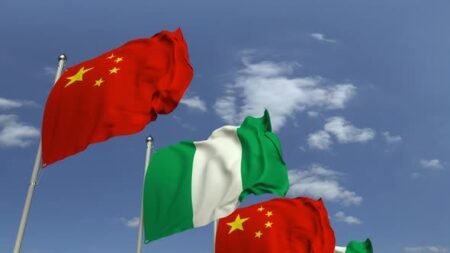








‘The implementation of tariffs and the subsequent retaliation could mark the start of a new era of global trade wars. Economists have warned the introduction of the import taxes by the US, and the responses from other countries, could lead to prices rising on a wide range of products, from cars, lumber, and steel to food and alcohol.’
SIAKA MOMOH
According to BBC News report, Donald Trump threatened to impose major tariffs upon taking office. And Canada, Mexico and China have vowed to respond to sweeping new tariffs to their exports to the US announced by President Donald Trump. Trump has kept his words. True to type, he has done it. We should get ready for the pains or act to mitigate them.
Trump said a levy of 25% on Canadian and Mexican imports as well as an additional 10% tax on Chinese goods would come into force on Tuesday. Canadian energy faces a lower 10% tariff.
The US president said the move was in response to his concerns about illegal immigration and drug trafficking – two of the main promises on which he was elected.
In response, both Canada and Mexico said they were preparing similar tariffs on US goods, while China added it would take “necessary countermeasures to defend its legitimate rights and interests”.
The implementation of tariffs and the subsequent retaliation could mark the start of a new era of global trade wars, said the BBC report.
Economists have warned the introduction of the import taxes by the US, and the responses from other countries, could lead to prices rising on a wide range of products, from cars, lumber, and steel to food and alcohol.
More on the report
China, Mexico and Canada to retaliate in kind
Consumers in all countries could see an increase in the cost of living if businesses decide to pass on higher costs to customers, with US industry groups already raising the alarm.
But Trump has indicated he is ready to escalate the duties further if the countries retaliate.
“Today’s tariff announcement is necessary to hold China, Mexico, and Canada accountable for their promises to halt the flood of poisonous drugs into the United States,” the White House said in a statement on X on Saturday.
Trump posted on his Truth Social platform: “This was done through the International Emergency Economic Powers Act (IEEPA) because of the major threat of illegal aliens and deadly drugs killing our Citizens, including fentanyl.”
How countries respond to Trump’s tariffs is what matters next, said the BBC report.
A tariff is a domestic tax levied on goods as they enter the country, proportional to the value of the import. They are a central part of Trump’s economic vision.
He sees them as a way of growing the US economy, protecting jobs and raising tax revenue – and in this case, pushing for policy action.
Together, China, Mexico and Canada accounted for more than 40% of imports into the US last year.
Canada, Mexico and the US have deeply integrated economies, with an estimated $2bn (£1.6bn) worth of manufactured goods crossing the borders daily.
In its announcement, the White House accused Mexico’s government of having “an intolerable alliance” with Mexican drug trafficking organisations.
In her response, Mexican President Claudia Sheinbaum called allegations that the Mexican government had alliances with criminal organisations “slander”.
Sheinbaum called on the US to do more to clamp down on the illegal flow of guns south to arm the cartels.
Her country is willing to work with the US, she said. “Problems are not resolved by imposing tariffs, but by talking.”
She instructed her economy minister to respond with tariff and non-tariff measures, which are expected to include retaliatory tariffs of 25% on US goods into Mexico.
Canada has already announced retaliatory tariffs against the US, with Canadian Prime Minister Justin Trudeau matching the 25% imposed on his country.
He set out “far-reaching” tariffs would affect 155bn Canadian dollars’ worth ($106.6bn; £86bn) of American goods ranging from beer and wine, to household appliances and sporting goods.
Non-tariff measures being considered are related to critical minerals and procurement, although Trudeau did not offer more detail.
“We don’t want to be here, we didn’t ask for this,” he said. “But we will not back down in standing up for Canadians.”
The Canadian prime minister pushed back on the suggestion the shared border posed a security concern, saying less than 1% of fentanyl going into the US comes from Canada. He also added less than 1% of illegal migrants entered the US through the border.
Canada is America’s largest foreign supplier of crude oil. According to the most recent official trade figures, 61% of oil imported into the US between January and November last year came from Canada.
China said it “firmly opposes” the tariffs, but has not yet announced any retaliatory measures. The 10% tax on its imports to the US will be added over and above tariffs already imposed on China by Trump in his first term and by President Joe Biden.
“Trade and tariff wars have no winners,” said a spokesperson at China’s Washington embassy.
Trump has acknowledged there could be “some temporary, short-term disruption” as a result of tariffs.
The car manufacturing sector could be especially hard hit. Parts cross the US, Canadian and Mexican borders multiple times before a final vehicle is assembled.
TD Economics suggested the import taxes could push up the average US car price by around $3,000, while the National Homebuilders Association said housing costs could increase.
The Canadian Chamber of Commerce said the levies would have “immediate and direct consequences on Canadian and American livelihoods” and will “drastically increase the cost of everything for everyone”.
The Farmers for Free Trade said with many US farmers already struggling, “adding tariffs to the mix would only exacerbate the situation across much of rural America”.
But the US Retail Industry Leaders Association, which includes big names such as Home Depot, Target and Walgreens among its more than 200 members, expressed hope tariffs could still be averted.
The White House, explaining on Saturday why it was targeting its top trading partners, said Mexican cartels were responsible for trafficking fentanyl, methamphetamine and other drugs.
It said tariffs on Canada would remain until it “co-operates with the US against drug traffickers and on border security”.
Lastly, it said “China plays the central role in the fentanyl crisis” with exports of the lethal synthetic painkiller.
Both the northern and southern US borders have reported drug seizures, though amounts at the border with Canada are considerably lower than those with Mexico, according to official data.
US border agents seized 43lbs (19.5kg) of fentanyl at the northern border between October 2023 and last September, compared to more than 21,000lbs (9,525.4kg) at the southern border.
Still, recent reports from Canadian intelligence agencies suggest a growing number of transnational organised crime groups are US th
Impact on Nigeria by these tariffs
Nairametrics reports Nigeria is not targeted directly, but its trade relationship with the US makes it matter for us to be worried.
It reeled out the following data: According to 2024 trade data,
• Nigeria exported approximately $5.29 billion worth of goods to the US while importing about $3.88 billion resulting in a trade surplus of $1.4 billion in Nigeria’s favour.
• In 2023, total trade between Nigeria and the US amounted to $8.27 billion. However, Nigeria maintained a trade surplus of $3.1 billion , exporting more to the US than it imported.
• Trade volume between the two countries has fallen by as much as 73%, in the last decade, primarily due to the US’s drastic reduction in crude oil imports from Nigeria.
• A historic review of trade data shows that in 2011, total trade between Nigeria and the US was $74 billion with Nigeria enjoying a trade surplus of $14 billion.
Comparatively, total trade between 2005 and 2014 reached $281.7 billion during which Nigeria ran a massive trade surplus of $200.2 billion with the US.
Additionally, Nigeria remains the second largest US export destination in Sub-Saharan Africa.
• US export to Nigeria include vehicles, wheat, machinery, fuels and plastics. Whilst Nigerian exports to the US comprise crude oil, cocoa, cashew-nuts and animal feed.
Nigeria also benefits from preferential trade agreements such as African Growth and Opportunity Act (AGOA).
Nigeria needs to put its acts together. We need to do something fast. One will want to believe our Ministry of Industry Trade and Investment has a strategy in place. The other day, Nigerian Minister of Industry Trade and Investment Jumoke Oduwole said ‘Nigeria is not worried’. Really? And Sunday Dare, Special Adviser on Public Affairs and Communication to President Tinubu said the WTO will manage the impact on the emerging global order. No. We need to do more. What with Nigeria relying heavily on the US for its used cars imports which were valued at $1.47 trillion in 2023.As at September, imports already stood at N892 billion! With used cars already beyond the reach of most Nigerians.
The implication of this for transport costs will be threatening. Transport inflation currently accounts for 10.7% of the total consumer price index(CPI). A rise in ‘tokunbo’ car prices, coupled with higher fuel costs, would increase public transportation costs, logistics and that of general goods and services. Where is this taking us? The pain is already there, we all know.
Story research source: BBC News, Nairametrics
Read the full article here