







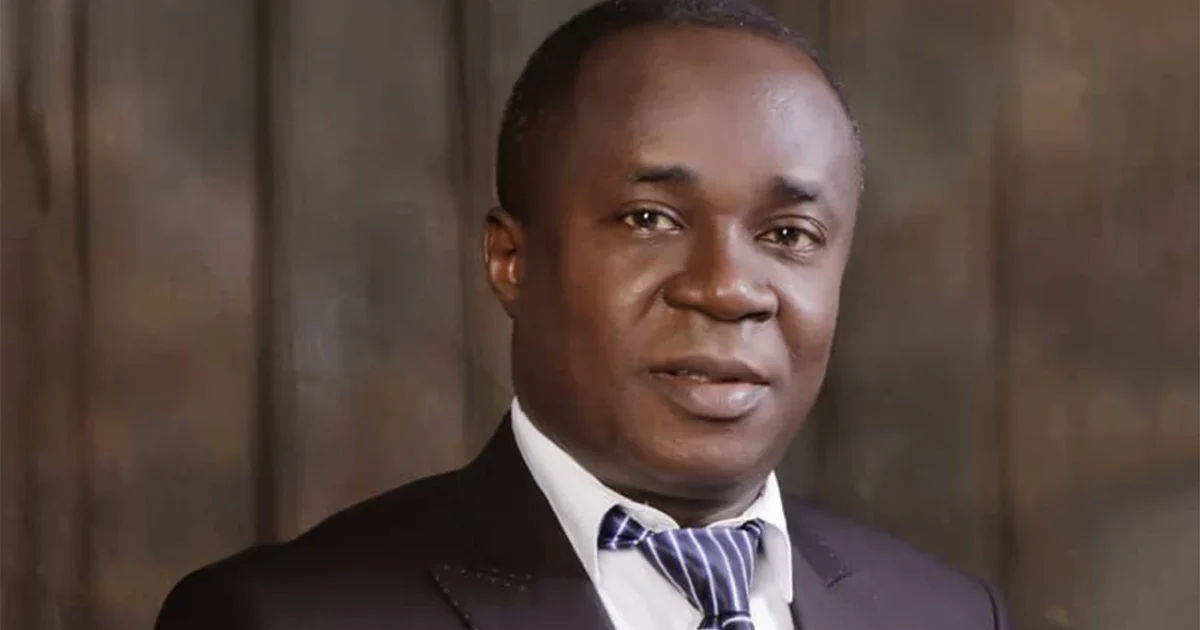
The President of the Capital Market Academics of Nigeria, Prof Uche Uwaleke, has urged the Central Bank of Nigeria to gradually reduce interest rates and revive development finance through specialised institutions, warning that persistently high borrowing costs are hurting investment, business expansion and job creation.
Uwaleke made the call on Monday in Abuja during a world press conference organised by CMAN, arguing that Nigeria’s inflation had become increasingly structural and could no longer be effectively tackled through repeated increases in interest rates alone.
He said, “CMAN respectfully advises that, as inflationary pressures become increasingly structural and cost-push in nature, monetary policy should gradually rely less on repeated increases in the Monetary Policy Rate as the primary instrument for controlling inflation. Excessively high interest rates, while helping to moderate aggregate demand, also increase the cost of borrowing, discourage productive investment and constrain business expansion.
“We therefore encourage a gradual moderation of the interest rate environment as inflation expectations continue to improve. This should, of course, be undertaken cautiously and supported by complementary fiscal measures aimed at addressing supply-side bottlenecks.”
On development finance, Uwaleke said the apex bank’s renewed emphasis on price stability should not result in the abandonment of targeted financing for productive sectors.
He said, “Accordingly, we call upon the Central Bank to create appropriate room for carefully designed development finance interventions through existing Development Finance Institutions. Rather than directly administering intervention programmes, the Bank can continue to provide strategic support through specialised institutions that possess the expertise to finance agriculture, manufacturing, exports, housing and small businesses.”
His comments come as the CBN under Governor Olayemi Cardoso has shifted away from direct intervention lending towards restoring price stability and investor confidence, retaining the Monetary Policy Rate at 26.5 per cent at its May 2026 meeting.
While commending the CBN’s reforms, Uwaleke praised the clearance of over $7bn in inherited foreign exchange obligations, the discontinuation of Ways and Means financing, banking sector recapitalisation and foreign exchange reforms, saying they had restored confidence in Nigeria’s financial system and improved the country’s standing among investors.
He also applauded the Federal Government for implementing long-delayed reforms, including fuel subsidy removal, foreign exchange unification and the Nigerian Tax Acts 2025, describing them as important steps towards restoring macroeconomic stability.
However, he said the benefits of those reforms had yet to reach many Nigerians.
According to him, “economic success should not be measured solely by rising stock prices, improving reserves or favourable sovereign ratings,” noting that many households and businesses continued to grapple with a high cost of living, weak purchasing power and limited access to affordable finance.
He said lending rates remained prohibitively high despite stronger banks, while private sector credit relative to Gross Domestic Product continued to decline.
Uwaleke noted that although headline inflation had eased to about 15.9 per cent, rural inflation remained elevated due to insecurity, poor infrastructure, inadequate storage facilities and unreliable electricity supply, while geopolitical tensions in the Middle East had added pressure through higher energy prices.
He said Nigeria’s economy grew by 3.89 per cent in the first quarter of 2026 but described the growth as modest because agriculture and manufacturing remained too weak to generate enough jobs and reduce poverty.
The economist also cautioned against Nigeria’s growing reliance on short-term foreign portfolio investment, noting that more than 95 per cent of the over $10bn in capital imported during the first quarter of 2026 came from portfolio investors rather than long-term foreign direct investment.
He urged the government to attract more productive investment through policy consistency, improved security and stronger contract enforcement.
Uwaleke further expressed concern over Nigeria’s public debt, which exceeded N159tn at the end of 2025, warning that widening fiscal deficits and low capital expenditure threatened infrastructure development.
He called for greater use of the capital market to finance infrastructure through project-linked instruments such as Sukuk and Green Bonds instead of relying heavily on conventional FGN Bonds, which account for nearly 80 per cent of domestic debt.
To deepen the capital market, he urged the Federal Government to encourage more indigenous and government-owned companies to list on the Nigerian Exchange by introducing tax incentives, including reducing Company Income Tax for listed firms from 30 per cent to 25 per cent.
He also commended the Securities and Exchange Commission and the Nigerian Exchange Group for reforms such as the T+1 settlement cycle and longer trading hours but urged regulators to further improve market liquidity, promote financial technology, sustainable finance and retail investor participation.
Uwaleke welcomed the forthcoming Capital Market Master Plan and the Investments and Securities Act 2025, saying both would strengthen investor protection and position Nigeria’s capital market for long-term growth.
He concluded that while recent reforms had improved macroeconomic stability, stronger banks, foreign exchange stability and investor confidence, their success would ultimately be judged by improvements in household welfare, affordable credit, infrastructure, job creation and poverty reduction.
“Our collective challenge is therefore to ensure that macroeconomic stability evolves into inclusive prosperity,” he said.
Read the full article here