
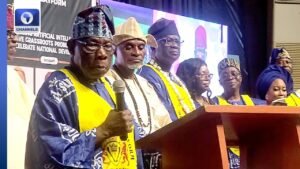




The newly appointed Managing Director of the Nigerian Railway Corporation (NRC), Dr Kayode Opeifa, on Thursday last week assumed office as the helmsman of the Nigerian railways, promising to prioritise ongoing projects.
Opeifa, promised to prioritise ongoing railway projects and modernise existing systems while focusing on safety and customer satisfaction towards making the Nigerian railway system become a world-class, efficient and safe mode of transportation.
“Our mission will be centered around transforming the rail sector in Nigeria into a world-class, efficient, and safe mode of transportation”, Opeifa said.
It’s quite certain that the incoming Managing Director will have his hands full and will need all the support he can muster to achieve any milestone in the snail paced corporation.
The use of the rail system was abandoned in the 80s resulting to lots of pressure on the roads, leading to busy and depreciating road network, causing lots of negative externalities in the form of road crashes, failed portions, carnage and deaths that is impacting negatively on national productivity and the economy in general.
Nigerian rail lines as at the year 2011 were 4,332 km, while the country has 193,200 km of roads, the rail just having less than 5% of the transportation network and less than 50% of these rail tracks are in operation across the Countr.
The so much talked about Lagos to Calabar rail network; a rail network that will service the ever busy south west of the country to the southeast and the south south, was not included in the first phase of construction works, neither was futuristic plan about explicit.
The roads in Nigeria is used today to freight over 95% of the total goods and services within the country, resulting in the terrible state of its road networks and short lifespans of the roads.
Even if the entire rail networks in Nigeria were to be in full operations, yet it will only be able to cater for a small chunk of the entire freight requirement of the country, while the time taken to use the rails to freight from point A to point B, is also a cause for concern owing to the antiquated train models still in use.
Apart from these short comings, there are many questions begging for answers when it comes to the time line for the completion of the rail lines being upgraded, it appears we will have to wait forever to get the first freight on the other rail tracks aside the over talked about Lagos to Ibadan and Abuja to Kaduna.
In 2022, the Federal Government, said about 3,318 kilometers of rail lines are being considered across the country.
This came as stakeholders insisted that unless Africa is linked by railway network, projected boost in intra-African trade, as envisaged under the African Continental Free Trade Area (AfCTA), would remained a mirage.
The proposed route alignments, according to him, are: Zaria-Funtua-Gusau-Kaura Namoda-Sokoto-Illela-Birnin Koni, which is 520km; Lagos-Ibadan-Oshogbo-Baro-Abuja, 615km; Ilela-Sokoto-Jega-Yauri-Makera, about 408km; Aba-Ikpene-Ibiono-Itu (Spur Uyo) Odudukpani-Calabar, about 340km, Calabar-Ikom-Obudu-Ogoja-Wukari-Yola-Maiduguri, 1,068km and Kano-Nguru-Gashua-Damaturu-Ngala, which is 707km.
The total network expansion is at about 3,318 kilometers.
The Federal Government disclosed that a 25-year strategic railway plan for Nigeria had suffered setback due to discrepancies in government policies; inadequate funding of the rail sector and absence of experienced private investors, among others.
Dr. Al-Mujtaba Abubakar, President of ACCI, said railway development in Africa demands urgent attention.
He noted that railway remains a climate-smart and efficient way to move people and freight.
Quoting an African Business Forum report, he said over 25 per cent of intra-African trade gains in services would go to transport alone; and nearly 40 per cent of the increase in Africa’s services production would be in transport under AfCFTA.
He said: “According to the research findings, AfCFTA requires 1,844,000 trucks for bulk cargo and 248,000 trucks for container cargo by 2030. This increases to 1,945,000 and 268,000 trucks, respectively, if planned infrastructure projects are also implemented.
Few weeks before leaving office, President Buhari approves the final authorisation on several amendments to Nigeria’s constitution, including moving railways from the exclusive legislative to the concurrent list.
The move means state governments can now deliberate on laws and policies to own and operate rail infrastructure across different states.
With state governments now able to control railway ownership and operations, the reaction has been positive—state governments are excited. In the same way, citizens and businesses are hopeful that this move will drive better transportation options across the country.
It took 40 years for the Lagos Blue Line to come to fruition. It was conceived by the first civilian governor of the state, Late Alhaji Lateef Jakande in 1983. The project became a reality 20 years after a former governor, now Nigeria’s President, Bola Tinubu, inaugurated it in 2003.
Recall that during the administration of former governor Babatunde Fashola, construction of the 27-kilometer rail started with the award of the contract, including the design and development of the rail infrastructure; the construction was to be done in phases.
Former governor Akinwunmi Ambode, who assumed office in 2015, promised that the project would be delivered in 2016. This, however, never happened.
In January 2023 however former President Muhammadu Buhari inaugurated its first phase, the Blue Line, while President Tinubu also commissioned the Lagos red line rail afterwards, both tracks are yet to impact on the transportation requirements of Lagos State so far.
The first phase of the Lagos Blue spans Marina to Mile 2, while the second phase covers Mile 2 to Okokomaiko. When completed, it will take about 35 minutes to complete an end-to-end trip on the blue line, with a total of 13 stops/stations, the government stated.
While the Nigerian economy has expanded over time (with occasional hiccups) and new centres of activities have emerged, the Nigerian railways have failed to respond to the potentially viable services and opportunities that exist.
In other words, in the last three decades in particular, not much has been achieved in terms of structural transformation of the Nigerian Railways, so as to meet potential demand for rail services as well as the rapidly emerging challenges of economic growth and national development.
By 1970s through to the early 1980s, both the volume of passengers and goods carried by the Nigerian Railway Corporation (NRC) had started to dropdramatically.
Unfortunately too, the fortunes of the rail transport sub-sector have declined so precipitously due to the enormity of the problems and challenges that confront it.
Read the full article here