







As part of its resolve to lift the nation’s capital market to its enviable position and achieve increased confidence in the market, the Security and Exchange Commission (SEC) said it has so far approved nine new issuances totaling N1.228 trillion in 2024.
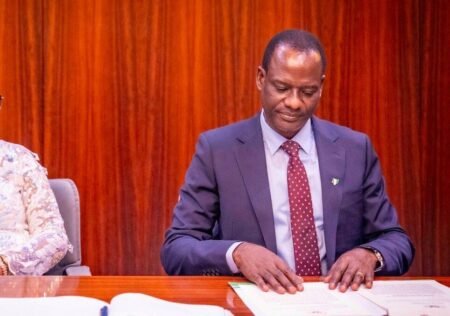
The Director General of the commission, Dr Emomotimi Agama,disclosed this while highlighting significant developments in the Nigerian capital market for 2024 at the first post-Capital Market Committee Press Conference to be held by the new management of the Commission.
In the fund management space, he noted that the Net Asset Value (NAV) of Registered Mutual Funds grew by 111.08% to ₦3.335 trillion, indicating a strong and sustainable growth.
Agama added that the SEC has, over time, demonstrated its commitment to protecting investors, as evidenced by the recent conviction of a Ponzi scheme operator, reinforcing its stance against market offenders. This, he noted, was a strong statement on the Commission’s unrelenting efforts at combating Ponzi schemes.
In terms of registration of market players, the bulk of Capital Market Operators (CMOs) and sponsored individual applications that were pending before the coming of the new management had all been processed and concluded as were appropriate.
Addressing unclaimed dividends, Agama noted that SEC is collaborating with stakeholders to reduce the volume of unclaimed dividends in Nigeria, aiming to report progress to the Senate Committee within the next six months.
He added that the SEC has also improved complaints management through the implementation of the Complaints Management Framework and the establishment of an Investor Protection Fund to restore investor confidence.
To manage systemic risks, he informed members that SEC had mandated CMOs to prepare and submit their enterprise risk management frameworks and annual risk profiles to the Commission. In efforts to assist Nigeria in exiting the FATF grey list, the Commission is collaborating with other financial sector regulators and agencies.
The CMC Chairman called on CMOs to ensure compliance with the Nigerian Sanctions Alert System and to enhance reporting on Politically Exposed Persons (PEPs) and Suspicious Transaction Reports (STRs).
He informed members of initiatives aimed at ensuring that the rulemaking process of the Commission becomes faster and more efficient. These include defragmenting the rules with a view of codifying the rules into a comprehensive rule book. Also, the Commission is presently updating rules on digital assets, has put in place guidelines for the banking recapitalisation exercise, as well as come up with guidelines for onboarding Virtual Assets Service Providers.
The Chairman noted that the fight against cybercrime remains a priority, with the Nigerian government implementing policies and establishing a cybersecurity committee within the capital market to manage and disseminate critical information, with the commission at the vanguard of the initiatives.
These initiatives underscore the SEC’s commitment to fostering a secure and robust capital market environment in Nigeria.
He informed members of other initiatives to safeguard investors in private bonds, noting that the Commission is reviewing its relevant rules and will soon release rules on private markets.
The Chairman expressed the determination of the Commission to continue to encourage companies to list and urged the exchanges to take steps to attract new listings to align with the government’s $1 trillion economy target.
He conveyed the Commission’s readiness to continue promoting capacity building on derivatives both for market operators and regulators. He also expressed optimism about unlocking the full potential of the capital market, in line with the Renewed Hope Agenda of the President Bola Ahmed Tinubu led administration.
Members received a presentation from the Chairman on his ‘Vision for the Market’, wherein he emphasised that the recent protests highlight the urgent need for public and private sector collaboration to sustain the economy during these challenging times. He stressed that the capital market must mobilise financing and facilitate the transfer of purchasing power from surplus to deficit sectors to reinforce Nigeria’s position as Africa’s leading economy.
As part of his presentation, the CMC Chairman suggested that CMOs should invest in modern technology to improve trading platforms and data dissemination and advised that introducing new products such as derivatives, REITs, and ETFs would attract investors.
Still in the presentation, the Chairman stated that strengthening regulatory bodies, enhancing enforcement, and adopting international best practices were essential to market efficiency, transparency and global competitiveness. Also, he noted that promoting good corporate governance, encouraging private sector investment, developing alternative assets, and incentivising corporate bond issuance are crucial to market growth and development. Additionally, more companies should be encouraged to list on the exchange to improve market making and liquidity.
As indicated earlier, members also received updates from CMC technical committees and heads of self-regulatory organisations.
The Technical Committee on Commodities Trading Ecosystem outlined its key plans to include integrating mining data into commodities exchanges, strengthening collaboration with Standards Organisation of Nigeria on commodity standards, deepening engagement with relevant ministries, and advancing preparations for the second International Conference on the Nigerian Commodities Market.
The update on e-dividend and direct cash settlement implementation revealed progress in API integration among registrars, with four already actively integrated and two nearing completion. However, seven registrars have yet to commence the process, and this raises concerns about their capabilities.
Regarding the payment of outstanding dividends for mandated accounts, compliance remains significantly low. Issues such as failed payments, dormant or closed accounts, and insufficient funding by public companies after reaching the 90% return threshold have been identified as contributing factors.
The Committee further noted that the flow of KYC data from secondary market transactions to registrars is showing improvements. However, a comprehensive approach is necessary. This involves transmitting all essential KYC information alongside transaction details in a standardised format. In addition, the Committee and NIBSS lamented the slow treatment of mandates by registrars and banks.
The Chairman concluded the meeting by emphasising the commitment of the new management to the CMC goals. He stressed the urgency for immediate action and reiterated the role of the CMC in driving Nigeria’s economic growth through innovation and collaboration.
Read the full article here