





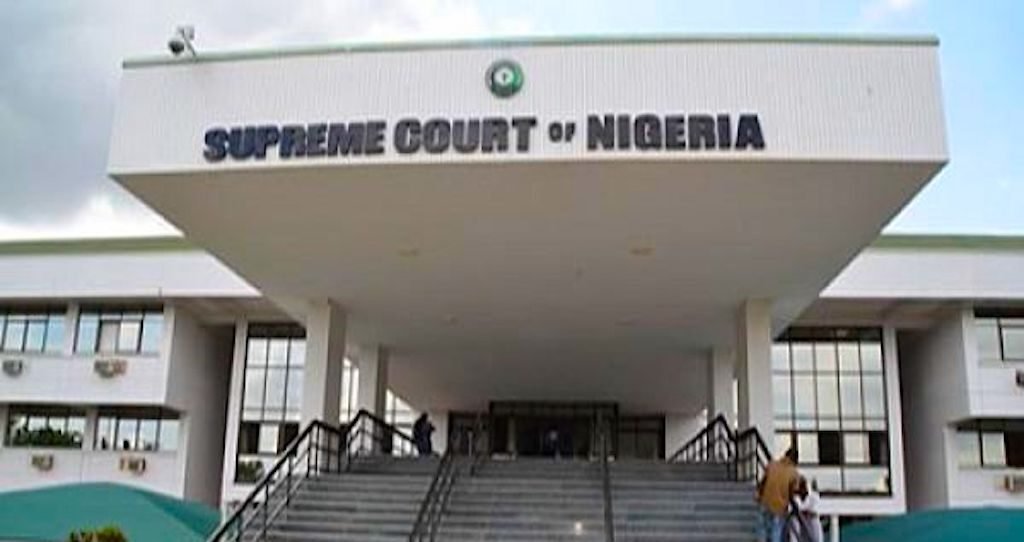
The Supreme Court of Nigeria on Friday dismissed a decision of the Court of Appeal ordering the seizure of FPSO Tamara Tokoni, a vessel containing crude oil pledged by oil-servicing firm General Hydrocarbons as collateral for a loan facility obtained from First Bank.
The five-member panel of judges, according to This Day newspaper, directed the release of the content of the vessel to General Hydrocarbons because the lawsuit initiated by the lender is contractual and not an admiralty matter.
In a similar vein, the court held that the Federal High Court and the Court of Appeal lack jurisdiction to hear the suit, given that the litigation is an admiralty dispute.
In September 2025, the Court of Appeal had ordered the sale of the crude oil aboard the vessel, directing that the proceeds be deposited in an interest-bearing escrow account under the custody of the chief registrar of the Court of Appeal.
The court threw out an earlier ruling of the Federal High Court, Port Harcourt, which dismissed First Bank’s claims over the diversion of proceeds from the sale of crude oil.


The appellate court affirmed the dispute’s maritime nature and emphasised the importance of preserving the res (the crude oil cargo) as the core subject of litigation.
Background
Atlantic Energy Drilling Concepts, chaired by Jide Omokore, an associate of a former Minister of Petroleum, Diezani Alison-Madueke, obtained a credit facility from First Bank in 2011.
The $490 million loan was to finance the firm’s operating and capital expenditure requirements for drilling four oil wells with proven reserves (collectively known as the Forcados assets) and to fund its Strategic Alliance Agreement with the Nigerian Petroleum Development Company (NPDC).
Atlantic Energy’s assets and rights were pledged as collateral, with First Bank holding a charge over the company’s collection accounts. The debt went bad after payment defaults by Atlantic Energy
“In line with our commitment to address the legacy asset quality challenges, exposure to Atlantic Energy, our biggest NPL (non-performing loan), was written off in the second quarter,” Adesola Adeduntan, First Bank’s former CEO, said in 2019.
According to its financial report, First Bank reduced its non-performing loan ratio to 14.5 per cent as of June 2019, down from 25.3 per cent, after writing off the N126 billion loan.
Oba Otudeko, then chairman of FBN Holdings (now First HoldCo), later sought the help of Nduka Obaigbena, owner of General Hydrocarbons, to salvage First Bank from a potentially disastrous situation. That prompted the duo to agree to work together, according to Mr Obaigbena, who held an approved oil mining lease (OML) from former President Umaru Yar’Adua.
In a letter written to Yemi Cardoso, the governor of the Central Bank of Nigeria, dated 7 November 2024 and seen by PREMIUM TIMES, Mr Obaigbena argued that the NNPC under late Maikanti Baru failed to sign the security documents for the now bad, non-performing loan to Atlantic Energy Drilling Concept Nigeria Limited (Atlantic Energy) for OML 26, OML 42, OML30 and OML 34 under separate Strategic Alliance Agreements between Atlantic Energy and NPDC Limited, claiming it was a fraudulent scheme to defraud the Federal Government by the then minister of petroleum resources, Diezani Allison-Madueke.
He noted that it was obvious during the meeting, which he claimed to be part of, that the facilities granted to Atlantic Energy by First Bank did not follow due process.
“FBN was now faced with an unsecured and non-performing exposure of $718M and was on the verge of becoming a systemic risk to the banking sector,” he stated.
“It was discovered that FBN had given this loan recklessly without security as part of a scheme that funded Diezani Allison-Madueke and Kola Aluko (details of these are still being investigated by Nigeria’s Economic and Financial Crimes Commission, EFCC, and the United Kingdom’s National Crime Agency, NCA),” Mr Obaigbena added.
He noted that First Bank, AMCON, and General Hydrocarbons signed a tripartite deed on outstanding exposure, allowing Global Hydrocarbons to guarantee payment of a pending, now-discounted, outstanding exposure of $600 million in naira on the bank’s books.
“Once GHL signed the Outstanding Exposure Tripartite Deed effective 31st December 2021, FBN’s account, which was then classified by the Central Bank of Nigeria (CBN), was now whole agai,n having escaped a loan loss provision of 302Bn Naira against a profit of 151Bn Naira ultimately declared for the year ending 31st December 2021,” the document stated.
Last September, Justice Ambrose Lewis-Allagoa of the Federal High Court in Lagos granted an injunction restraining AMCON from appointing a receiver over General Hydrocarbons and its assets.
The court also forbade AMCON, its managing director, First Bank and the attorney general of the federation from taking any steps or continuing any moves to enforce any rights against the energy firm or its assets.
The rights, the court said, included “but not limited to freezing the accounts of the applicant, its directors or shareholders, the appointment of a receiver/receiver manager, asset manager, recovery agent, etc., over the applicant, the applicant’s assets, or the assets belonging to the applicant’s directors or shareholders.”
On 28 October 2025, General Hydrocarbons was directed by an arbitral tribunal to pay First Bank of Nigeria $112,100 and N111.25 million in legal and arbitration costs.
Justice Akaah Kumai, who gave the order, said failure by General Hydrocarbons to comply will attract a 10 per cent annual interest rate until full settlement.
The tribunal dismissed the allegation that First Bank sabotaged alternative financing arrangements on the ground that the claim lacked merit.
It also ruled that General Hydrocarbons was not entitled to any damages, expenses, or compensation for third-party contractors, unpaid salaries, or failed contracts.
Seyi Akinwunmi, the receiver/manager appointed by AMCON, disclosed in a newspaper advertisement dated 6 November 2025 announcing his appointment as receiver/manager over General Hydrocarbons, stating that the oil firm is now under receivership.
On the same day, AMCON formally requested that thirty-four financial institutions in Nigeria block access to the assets (including funds) held by them on behalf of the company.
“At the time AMCON appointed me receiver manager, there was no order against me. I was appointed under the law, and I am operating according to law,” Mr Akinwunmi told PREMIUM TIMES.
A lawyer of General Hydrocarbons informed PREMIUM TIMES at the time that AMCON had obtained the order to enforce the receivership from a court of equal jurisdiction presided over by Justice Adetayo Aluko.
The receiver/manager’s ploy to draft in a new lawyer – Oluseye Opasanya – into the legal battle to replace Abiodun Laniyonu, who had represented General Hydrocarbons right from the start of the tussle, hit a brick wall.
READ ALSO: Supreme Court upholds final forfeiture of N1.58 billion linked to former NIRSAL consultant
Justice Lewis-Allagoa said the step ran contrary to a current court order and quashed the move on that basis.
In December 2025, the Lagos Division of the Federal High Court struck out the order empowering AMCON to enforce receivership over General Hydrocarbons.
Justice Akintayo Aluko, who announced the decision, said a suit initiated by the receiver/manager appointed by AMCON is an abuse of court process in light of a subsisting order issued by the same court.
Mr Akinwunmi, the judge added, launched legal proceedings in disregard for the injunction granted by Justice Ambrose Lewis-Allagoa in September, restraining AMCON, its agents, privies, nominees, etc, from appointing a receiver over General Hydrocarbons and its assets.
Read the full article here