









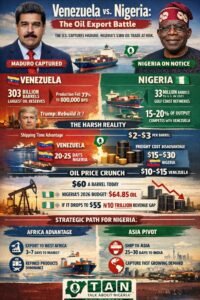

On January 3rd, 2026, U.S. forces captured Venezuelan President Nicolás Maduro in a dramatic military operation. Within hours, President Trump announced plans to rebuild Venezuela’s oil sector, promising American companies access to the world’s largest proven reserves — 303 billion barrels. For Nigeria, this isn’t just a headline—it’s a direct threat to our $2.9 billion oil export relationship with the United States.
Here is the brutal reality for Nigeria:
The Logistics Trap: Venezuelan crude reaches U.S. Gulf Coast refineries in 5–7 days. Nigerian crude takes 20–25 days. That is a $2–$3 per barrel freight disadvantage we simply cannot erase.
The Infrastructure Match: U.S. Gulf refineries were literally built to “eat” Venezuelan heavy crude. Nigerian light sweet crude has been a temporary substitute, not a permanent preference.
The Price War: At $60/barrel, Nigeria’s margins are razor-thin. If Venezuelan barrels (produced at $10-$15/bbl) flood the market, prices could easily slide to $50, blowing a ₦10 trillion hole in our national budget.
The Budgetary Breaking Point. The Nigerian Senate recently lowered our 2026 budget benchmark to $60.00. However, with the global market currently drowning in excess supply, we are already flirting with a revenue shortfall. If oil drops to $55, the gap becomes unmanageable.
Nigeria’s Strategic “Counter-Punch” Is it all doom and gloom? Not necessarily. While we may lose the U.S., geography gives us other weapons:
The India Advantage: Venezuelan crude takes 40 days to reach India via the Panama Canal. Nigeria gets there in 25 days. We must pivot our crude exports aggressively toward the world’s fastest-growing demand center in Asia.
The Refined Product Dominance: This is where the Dangote Refinery becomes our ultimate shield. While Venezuela struggles to rebuild its broken refineries, Nigeria can dominate the West African market. Dangote’s refined products reach regional neighbors in 3 days; Venezuela takes nearly 20.
The Bottom Line The “Maduro capture” is a wake-up call. We can no longer rely on the U.S. market as a safety net. Nigeria’s survival depends on two things: dominating the African refined products market and securing long-term buyers in Asia, where our geography actually works for us.
The 18-year era of analyzing African energy has taught us one thing: Headlines hide fundamentals. The fundamental today? Nigeria must act now, or be left behind in the “New Oil Order.”